Google Ads remains one of the most powerful digital marketing platforms available to businesses in 2026. Whether you are a local service provider, an ecommerce brand, a SaaS company, or a multinational enterprise, Google Ads offers the opportunity to connect with potential customers precisely when they are searching for products and services like yours.
However, simply launching a campaign is not enough. Many advertisers spend thousands of dollars every month without achieving the results they expect. Some struggle with rising costs per click, others generate traffic that never converts, and many fail to understand where their advertising budget is actually going.
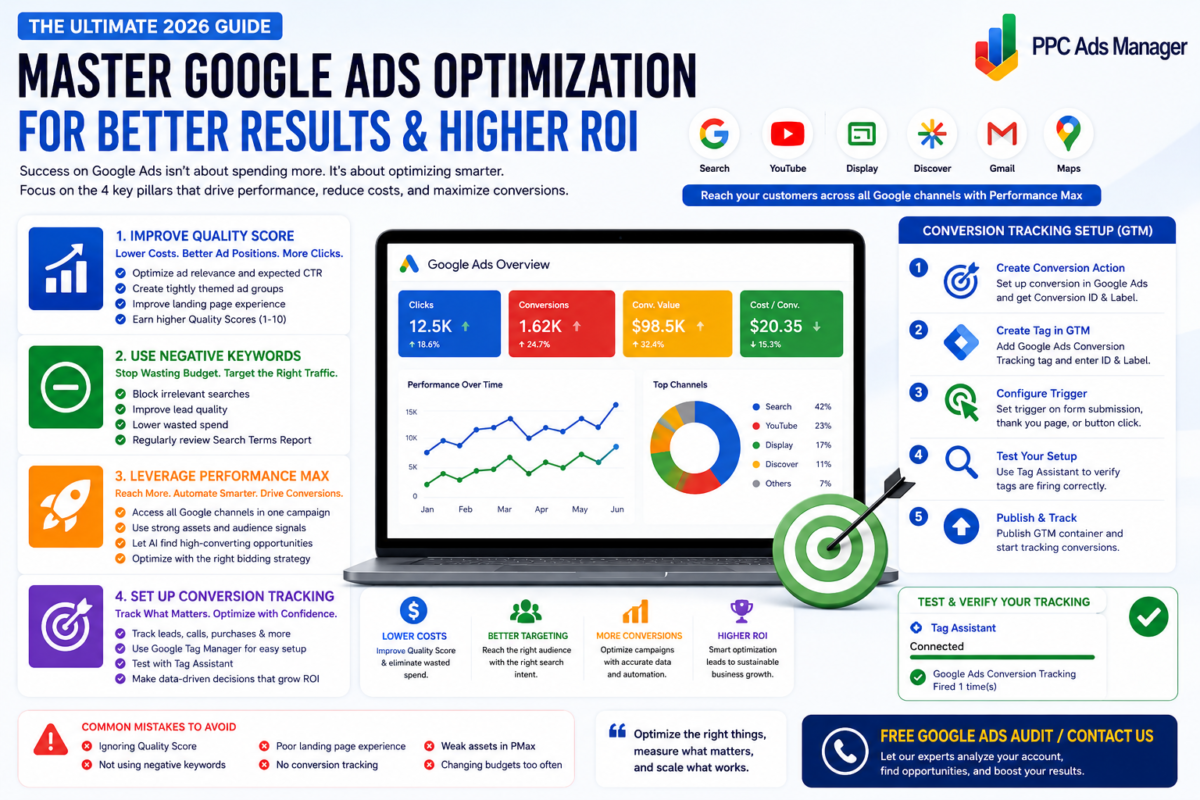
The difference between an average Google Ads account and a highly profitable one often comes down to mastering four critical areas: Quality Score, Negative Keywords, Performance Max Campaigns, and Conversion Tracking. These components form the foundation of a successful Google Ads strategy and influence everything from campaign efficiency to return on investment.
This comprehensive guide explores each of these pillars in depth and explains how they work together to create sustainable advertising success.
Why Google Ads Still Dominates Digital Advertising
Despite the rise of social media platforms and emerging advertising channels, Google Ads continues to be one of the most effective methods for generating qualified leads and sales.
Unlike interruption based advertising, Google Ads targets users who are actively searching for solutions. This means advertisers can reach potential customers at the exact moment they are expressing intent.
For example, a person searching for “solar panel installation near me” or “Google Ads management services” is already interested in finding a solution. This intent driven behavior makes Google Ads particularly valuable.
However, competition on the platform has increased significantly over the years. Costs continue to rise, industries become more crowded, and Google’s algorithms are becoming increasingly sophisticated. To remain competitive, advertisers must optimize every aspect of their campaigns.
This is where the four pillars become essential.
Pillar One: Understanding and Improving Google Ads Quality Score
Quality Score is one of the most misunderstood metrics in Google Ads. Many advertisers see the score but fail to understand its impact on campaign performance.
Quality Score is Google’s rating of the relevance and quality of your keywords, advertisements, and landing pages. It is measured on a scale from 1 to 10.
A higher Quality Score generally results in:
- Lower cost per click
- Better ad positions
- Improved visibility
- Higher click through rates
- Better return on advertising spend
Google wants users to have a positive experience. Therefore, it rewards advertisers who provide relevant advertisements and useful landing pages.
The Three Components of Quality Score
Expected Click Through Rate
Expected Click Through Rate predicts how likely users are to click on your advertisement after seeing it.
Advertisements that consistently receive strong engagement indicate relevance and usefulness.
To improve click through rates:
- Write compelling headlines
- Include clear benefits
- Use persuasive calls to action
- Highlight unique selling points
- Test multiple ad variations
Ad Relevance
Ad relevance measures how closely your advertisement aligns with a user’s search query.
For example, if someone searches for “Google Ads audit services,” an advertisement specifically mentioning Google Ads audits will generally perform better than a generic digital marketing advertisement.
Improving ad relevance involves:
- Creating tightly themed ad groups
- Matching advertisements to keywords
- Using keywords naturally within ad copy
- Aligning messaging with user intent
Landing Page Experience
Many advertisers focus heavily on advertisements while neglecting landing pages.
Google evaluates:
- Page speed
- Mobile responsiveness
- Content quality
- Navigation
- Relevance to the advertisement
A strong landing page experience improves both Quality Score and conversion rates.
Why Quality Score Matters
Quality Score is not merely a reporting metric. It directly influences how much you pay and where your advertisements appear.
Two advertisers may bid the same amount, but the advertiser with the stronger Quality Score often secures a better position while paying less.
This makes Quality Score one of the most cost effective optimization opportunities available.
Pillar Two: Using Negative Keywords to Eliminate Wasted Spend
While Quality Score helps improve efficiency, negative keywords help eliminate waste.
Many advertisers focus entirely on attracting traffic. The smarter approach is attracting the right traffic.
Negative keywords tell Google when not to show your advertisements.
Without proper negative keyword management, campaigns often waste substantial portions of their budgets on irrelevant searches.
What Are Negative Keywords?
Negative keywords are terms that prevent your advertisements from appearing when those words are included in a search query.
For example, a company selling premium consulting services may want to exclude terms such as:
- Free
- Jobs
- Internship
- Training
- Course
- Certification
These searches rarely generate paying customers.
Why Negative Keywords Matter
Benefits include:
- Lower advertising costs
- Better lead quality
- Improved click through rates
- Increased conversion rates
- Stronger campaign relevance
- Better return on investment
Even small negative keyword improvements can generate significant budget savings over time.
Understanding Negative Match Types
Broad Match Negatives
Broad match negatives prevent advertisements from appearing when all negative keyword terms exist within the search query.
Phrase Match Negatives
Phrase match negatives block searches containing a specific phrase in the exact order.
Exact Match Negatives
Exact match negatives prevent advertisements from appearing only when the search query exactly matches the negative keyword.
Finding Negative Keyword Opportunities
One of the most valuable reports in Google Ads is the Search Terms Report.
This report reveals the actual searches that triggered your advertisements.
By reviewing this data regularly, advertisers can identify:
- Irrelevant traffic
- Poor quality leads
- Expensive non converting searches
- Informational queries with low commercial intent
Successful advertisers review search terms consistently and continuously expand their negative keyword lists.
Starter Negative Keyword Categories
Useful categories often include:
- Employment related terms
- Educational searches
- Free resources
- Competitor irrelevance
- Geographic exclusions
- Customer support searches
Negative keywords are often the fastest way to improve campaign profitability.
Pillar Three: Mastering Performance Max Campaigns
Performance Max has become one of Google’s most important campaign types.
As artificial intelligence continues to evolve, Google increasingly relies on automation to drive advertising performance.
Performance Max provides access to:
- Search
- Display
- YouTube
- Discover
- Gmail
- Maps
All within a single campaign.
What Makes Performance Max Different?
Traditional campaigns require advertisers to manage:
- Keywords
- Placements
- Bids
- Audiences
- Channels
Performance Max automates much of this process.
Google’s machine learning determines:
- Who sees advertisements
- Where advertisements appear
- Which assets perform best
- How budgets are allocated
Benefits of Performance Max
Key advantages include:
- Greater reach
- Simplified management
- Automated optimization
- Improved conversion opportunities
- Cross channel visibility
Performance Max is particularly effective for businesses focused on:
- Lead generation
- Ecommerce sales
- Appointment bookings
- Customer acquisition
Building Strong Asset Groups
Asset Groups are the foundation of Performance Max campaigns.
Each group contains:
- Headlines
- Long headlines
- Descriptions
- Images
- Videos
- Logos
- Calls to action
Google combines these assets dynamically based on user behavior and platform requirements.
The quality of your assets significantly influences campaign performance.
The Importance of Audience Signals
Audience signals help guide Google’s automation.
Examples include:
- Customer lists
- Website visitors
- Remarketing audiences
- Custom segments
- In market audiences
While audience signals do not restrict targeting, they provide valuable starting points for Google’s learning process.
Budget and Bidding Considerations
Performance Max performs best when provided with:
- Sufficient conversion data
- Consistent budgets
- Realistic bidding targets
Frequent adjustments often disrupt learning and reduce performance.
Patience is crucial during the initial learning phase.
Common Performance Max Challenges
Despite its strengths, Performance Max has limitations.
These include:
- Reduced keyword visibility
- Less placement transparency
- Limited manual control
- Dependence on quality conversion data
Advertisers who understand these limitations can implement strategies to maintain oversight while benefiting from automation.
Pillar Four: Conversion Tracking as the Foundation of Optimization
No Google Ads strategy can succeed without accurate conversion tracking.
Many advertisers focus on clicks, impressions, and traffic. However, these metrics do not necessarily translate into business growth.
Conversions represent meaningful actions such as:
- Purchases
- Lead submissions
- Phone calls
- Bookings
- Consultations
Tracking these actions provides the data needed for optimization.
Why Conversion Tracking Is Essential
Conversion tracking enables advertisers to:
- Measure campaign success
- Evaluate profitability
- Improve bidding strategies
- Understand customer behavior
- Scale successful campaigns
Without conversion tracking, optimization becomes guesswork.
Common Conversion Types
Lead Generation Conversions
These include:
- Contact forms
- Quote requests
- Consultation bookings
- Demo requests
Phone Call Conversions
Important for service businesses and local companies.
Ecommerce Conversions
Track:
- Purchases
- Revenue
- Transaction values
- Product performance
Page Based Conversions
Thank you pages often serve as confirmation points for successful actions.
Using Google Tag Manager
Google Tag Manager simplifies conversion tracking implementation.
Benefits include:
- Easier deployment
- Reduced developer dependency
- Greater flexibility
- Centralized management
Through Google Tag Manager, advertisers can install and manage tracking tags efficiently.
Testing and Validation
Implementation is only the beginning.
Advertisers should verify:
- Tags fire correctly
- Conversion values are accurate
- No duplicate tracking exists
- Triggers activate properly
Google Tag Assistant is a valuable tool for testing setups.
Cross Device and Offline Conversions
Modern customer journeys rarely occur on a single device.
A user may:
- Discover a business on mobile
- Research on desktop
- Convert on another device
Cross device tracking helps connect these interactions.
Offline conversion imports further enhance visibility by connecting online advertising efforts with offline sales outcomes.
How All Four Pillars Work Together
The true power of Google Ads emerges when these four elements work together.
Quality Score improves efficiency and reduces costs.
Negative keywords eliminate waste.
Performance Max expands reach and leverages automation.
Conversion tracking provides the data needed for intelligent decision making.
Consider the following scenario:
A business launches a Performance Max campaign with exceptional creative assets. Conversion tracking is configured correctly, allowing Google’s machine learning to identify high quality leads. Negative keywords eliminate irrelevant traffic, while strong Quality Scores keep advertising costs under control.
Each component reinforces the others.
Without conversion tracking, Google’s automation lacks meaningful data.
Without negative keywords, budgets are wasted.
Without Quality Score optimization, costs increase unnecessarily.
Without Performance Max, businesses may miss valuable opportunities across Google’s ecosystem.
The most successful advertisers view these components as interconnected rather than separate strategies.
The Future of Google Ads in 2026 and Beyond
Google Ads continues moving toward automation, machine learning, and data driven optimization.
Advertisers who embrace these changes while maintaining strategic oversight will gain a competitive advantage.
Future success will depend on:
- Strong first party data
- High quality creative assets
- Accurate conversion tracking
- Intelligent audience targeting
- Continuous optimization
Technology will continue evolving, but the fundamental principles of relevance, efficiency, and measurement will remain constant.
Conclusion
Google Ads remains one of the most powerful growth channels available to businesses. However, sustainable success requires more than simply launching campaigns and increasing budgets.
Quality Score helps reduce costs and improve visibility. Negative keywords prevent wasted spending. Performance Max unlocks the full potential of Google’s advertising ecosystem. Conversion tracking provides the data necessary for informed decision making and ongoing optimization.
Together, these four pillars create the foundation of a profitable Google Ads strategy in 2026.
Businesses that master these areas consistently generate better leads, achieve stronger conversion rates, reduce acquisition costs, and maximize return on investment.
Ready to Take Your Google Ads Performance to the Next Level?
Whether you need help improving Quality Score, building advanced negative keyword strategies, optimizing Performance Max campaigns, or implementing accurate conversion tracking, our team can help identify opportunities for growth and efficiency.
Free Google Ads Audit | Contact Us
Speak with our Google Ads specialists today at Contact us – Free Google Ads Audit and discover how expert optimization can help you reduce costs, improve conversions, and unlock the full potential of your advertising campaigns.
Frequently Asked Questions
What is the most important factor for Google Ads success?
There is no single factor that guarantees success. High performing campaigns typically combine strong Quality Scores, accurate conversion tracking, well managed negative keywords, and effective bidding strategies. When these elements work together, campaigns become more efficient and profitable.
What is a good Google Ads Quality Score?
A Quality Score between 7 and 10 is generally considered excellent. Scores within this range indicate that your advertisements, keywords, and landing pages are highly relevant to users and are likely to benefit from lower costs and better ad positions.
How often should I review negative keywords?
Negative keywords should be reviewed regularly, ideally every week for active campaigns. Monitoring your Search Terms Report helps identify irrelevant searches and prevents unnecessary spending.
Are negative keywords really that important?
Yes. Negative keywords are one of the fastest ways to improve campaign efficiency. They help eliminate unqualified traffic, improve lead quality, and ensure your budget is focused on users who are more likely to convert.
What are Performance Max campaigns?
Performance Max campaigns are Google’s automated campaign type that allows advertisers to reach customers across Search, YouTube, Display, Discover, Gmail, and Maps from a single campaign. Google’s machine learning automatically determines where ads should appear to maximize conversions.
Should I use Performance Max or Search campaigns?
The answer depends on your objectives. Search campaigns provide greater keyword control and visibility, while Performance Max offers broader reach and automated optimization. Many successful advertisers use both campaign types together to maximize results.
How long does it take for a Performance Max campaign to perform well?
Most Performance Max campaigns require a learning period of at least two to six weeks. During this time, Google’s algorithms gather data and optimize targeting, bidding, and asset combinations.
What are audience signals in Performance Max?
Audience signals help guide Google’s machine learning toward users who are more likely to convert. Examples include customer lists, website visitors, remarketing audiences, and custom segments.
Why is conversion tracking important?
Conversion tracking allows you to measure valuable actions such as purchases, phone calls, form submissions, and bookings. Without tracking, it becomes difficult to determine which campaigns are generating real business results.
What conversions should I track in Google Ads?
You should track actions that directly contribute to business growth, including:
- Lead form submissions
- Phone calls
- Online purchases
- Appointment bookings
- Quote requests
- Contact form completions
Can Google Ads work without conversion tracking?
Technically yes, but performance will be severely limited. Google’s automated bidding strategies rely on conversion data to optimize campaigns effectively. Without accurate tracking, campaign decisions are based on incomplete information.
What is Google Tag Manager and why should I use it?
Google Tag Manager is a tag management platform that allows marketers to install and manage tracking codes without directly editing website code. It simplifies conversion tracking implementation and provides greater flexibility for campaign management.
How can I reduce my Google Ads costs?
Several strategies can help reduce costs:
- Improve Quality Score
- Add negative keywords regularly
- Optimize landing pages
- Refine audience targeting
- Improve conversion rates
- Use accurate conversion tracking
How often should Google Ads campaigns be optimized?
Campaigns should be reviewed regularly. Most advertisers benefit from weekly performance checks and monthly optimization reviews. High spending accounts may require more frequent monitoring.
Can small businesses benefit from Google Ads?
Absolutely. Google Ads allows businesses of all sizes to target highly specific audiences. With proper optimization and budget management, small businesses can compete effectively and generate high quality leads.
What is the biggest mistake advertisers make?
One of the most common mistakes is focusing only on clicks instead of conversions. Traffic alone does not generate revenue. Successful advertisers prioritize lead quality, conversion tracking, and return on investment rather than vanity metrics.