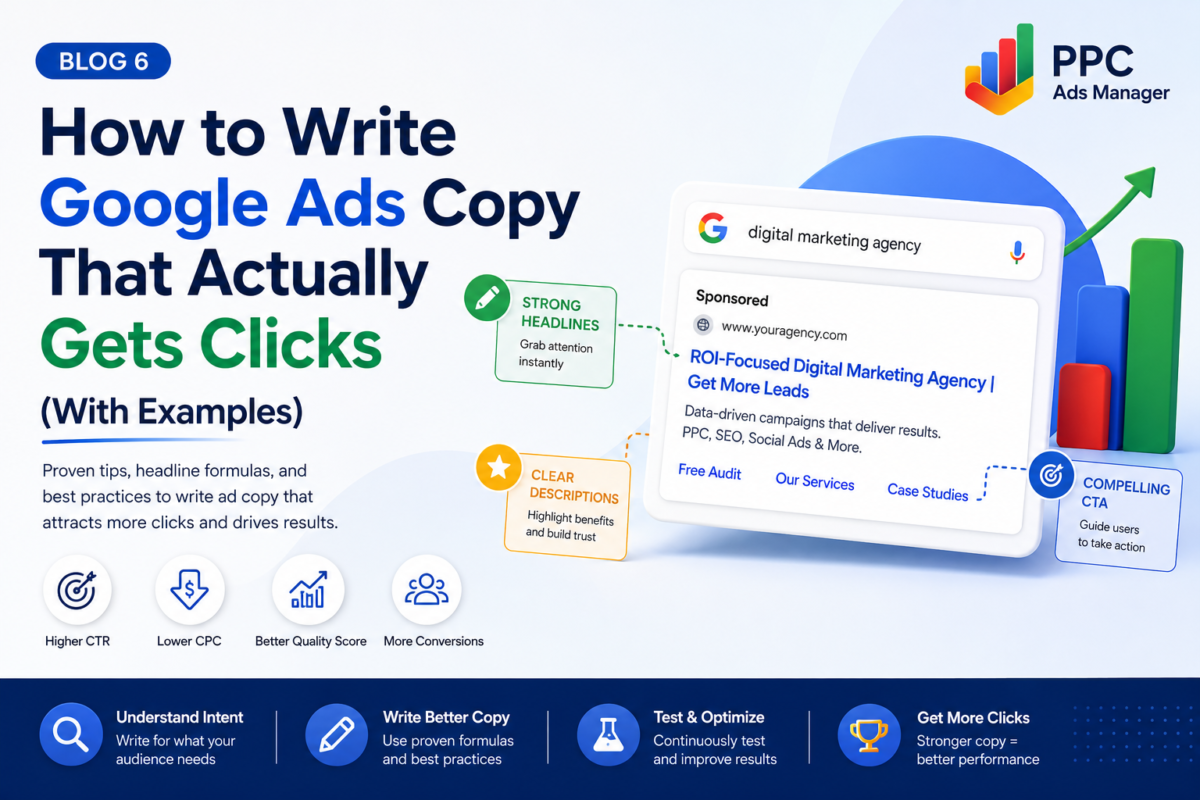
Google Ads can place your business in front of the right audience at the exact moment they are searching for a solution. Yet many advertisers focus heavily on targeting, bidding, and budgets while overlooking one of the most influential factors behind campaign performance: ad copy.
Your ad copy is often the first interaction a potential customer has with your brand. A compelling message can attract clicks, improve Quality Score, lower costs, and increase conversions. Poorly written copy, on the other hand, can cause even the most carefully planned campaigns to underperform.
If you have ever wondered why competitors seem to attract more clicks despite offering similar products or services, the answer often lies in the words they use.
This guide covers practical Google Ads ad copy tips, Responsive Search Ads best practices, headline formulas, description writing techniques, and real-world examples to help you create ads that people actually want to click.
Why Ad Copy Is Half the Battle
Many advertisers assume success comes down to budget size. While budget certainly matters, the effectiveness of your message often has a greater impact on performance.
Think about what happens when someone searches on Google. They are presented with multiple ads and organic results. Every advertiser is competing for the same attention.
The question is simple:
Why should a user click your ad instead of someone else’s?
Your ad copy provides that answer.
Strong ad copy helps:
- Increase Click Through Rate (CTR)
- Improve Quality Score
- Lower Cost Per Click (CPC)
- Generate more qualified traffic
- Increase conversion rates
Even the best landing page cannot convert visitors who never click your ad in the first place.
If you have not already, read our guide on Best Landing Page Strategy for Google Ads to ensure your landing page experience matches your messaging.
Understanding Responsive Search Ads (RSA)
Google now primarily uses Responsive Search Ads, commonly called RSAs.
Instead of creating a single static ad, advertisers provide multiple headlines and descriptions. Google’s machine learning then tests various combinations to determine which versions perform best.
How Responsive Search Ads Work
You can provide:
- Up to 15 headlines
- Up to 4 descriptions
Google automatically mixes and matches these assets to create different ad variations.
This approach allows advertisers to test numerous combinations without manually creating dozens of ads.
RSA Best Practices
To maximize performance:
- Use all available headline slots whenever possible
- Include primary keywords naturally
- Highlight different benefits in different headlines
- Mix short and long headlines
- Include offers, pricing, and trust signals
- Avoid repeating the same message repeatedly
For example:
Weak Headlines
- Digital Marketing Agency
- Marketing Experts
- Online Marketing Services
Better Headlines
- Digital Marketing Agency for Small Businesses
- Get More Leads With Data-Driven Campaigns
- Certified PPC Experts Delivering Results
- Free Strategy Consultation Available
- ROI-Focused Marketing Solutions
Notice how the second set provides specific value instead of generic descriptions.
Writing High-CTR Headlines
Headlines are the most visible part of your ad. They often determine whether someone clicks or scrolls past.
1. Include the Searcher’s Keyword
People naturally pay attention to words they just searched for.
If someone searches:
“Google Ads Management Services”
A headline like:
Professional Google Ads Management Services
immediately signals relevance.
Keyword relevance can significantly improve CTR and Quality Score.
2. Focus on Benefits, Not Features
Many advertisers talk about what they do.
Successful advertisers focus on what customers gain.
Compare:
Feature-Based Headline
- Experienced Marketing Team
Benefit-Based Headline
- Generate More Qualified Leads Faster
Benefits create emotional motivation.
3. Use Numbers Whenever Possible
Numbers grab attention and make claims feel more credible.
Examples:
- Save Up to 30% on Advertising Costs
- 500+ Successful Campaigns Managed
- Results in as Little as 14 Days
- Free Audit Within 24 Hours
Specificity often outperforms vague statements.
4. Create Urgency Carefully
Urgency can increase clicks when used honestly.
Examples:
- Limited-Time Summer Offer
- Book Your Free Consultation Today
- Ends This Friday
- Spots Available This Month
Avoid false urgency. Users quickly lose trust when every promotion appears permanently urgent.
5. Highlight Your Unique Selling Proposition
Ask yourself:
Why should someone choose you?
Examples:
- Google Premier Partner Agency
- Dedicated Account Manager Included
- No Long-Term Contracts
- Industry-Specific PPC Experts
Your USP should appear prominently in at least one headline.
Description Line Best Practices
While headlines capture attention, descriptions provide supporting information that encourages action.
Strong descriptions answer three questions:
- What do you offer?
- Why should users trust you?
- What should they do next?
Keep It Clear
Avoid unnecessary jargon.
Instead of:
“We leverage omnichannel marketing frameworks for scalable acquisition.”
Try:
“Increase leads and sales with targeted campaigns managed by certified PPC experts.”
Clarity almost always wins.
Emphasize Outcomes
Customers care about results.
Examples:
- Generate More Leads
- Increase Online Sales
- Reduce Advertising Waste
- Improve Return on Ad Spend
Focus on solving problems rather than describing services.
Build Trust
Trust signals reduce hesitation.
Examples:
- 5-Star Client Reviews
- Certified Google Ads Specialists
- Trusted by 500+ Businesses
- Transparent Reporting Every Month
Social proof often improves ad performance.
End With a Clear CTA
Never assume users know what to do next.
Include direct calls to action such as:
- Book Your Free Consultation
- Get Your Free Audit Today
- Request a Quote
- Start Your Campaign Now
- Schedule a Strategy Call
Clear instructions create momentum.
Using Dynamic Keyword Insertion (DKI)
Dynamic Keyword Insertion automatically inserts the user’s search term into your ad whenever possible.
For example:
Headline Template:
Buy {KeyWord:Running Shoes} Online
Search Query:
“Men’s Trail Running Shoes”
Possible Ad Headline:
Buy Men’s Trail Running Shoes Online
Benefits include:
- Increased relevance
- Higher CTR potential
- Better alignment with search intent
However, use DKI carefully.
Avoid situations where automatically inserted keywords could create awkward, misleading, or grammatically incorrect headlines.
Always review likely keyword variations before implementation.
Ad Copy for Different Intent Stages
Not every searcher is ready to buy immediately.
Understanding user intent helps you write more effective ads.
Awareness Stage
At this stage, users are researching and learning.
Examples:
- What Is Google Ads?
- How Does PPC Work?
- Benefits of Digital Marketing
Awareness-stage ads should educate and build interest.
Example:
Headline
Learn How Google Ads Can Grow Your Business
Description
Discover proven PPC strategies that help businesses attract more leads and increase visibility online.
The goal is engagement, not immediate selling.
Consideration Stage
Users are comparing options.
Examples:
- Best PPC Agency
- Google Ads Management Services
- Marketing Agency Reviews
Ad copy should focus on differentiation.
Example:
Headline
Award-Winning Google Ads Specialists
Description
Get expert campaign management, transparent reporting, and measurable growth from certified PPC professionals.
Purchase Intent Stage
Users are ready to act.
Examples:
- Hire Google Ads Agency
- PPC Management Pricing
- Book Google Ads Consultant
These ads should emphasize action.
Example:
Headline
Get a Free Google Ads Audit Today
Description
Identify wasted spend and uncover growth opportunities. Schedule your consultation now.
The stronger the purchase intent, the stronger your CTA should become.
Before and After Ad Copy Examples
One of the best ways to improve ad writing is by studying transformations.
Example 1: Marketing Agency
Before
Headline:
Digital Marketing Agency
Description:
We provide marketing services for businesses. Contact us for more information.
After
Headline:
Generate More Leads With Expert PPC Management
Description:
Increase sales and reduce wasted spend with certified Google Ads specialists. Get a free account audit today.
Why it works:
- Benefit-focused
- Specific outcome
- Strong CTA
- Increased credibility
Example 2: Online Course
Before
Headline:
Digital Marketing Course
Description:
Learn digital marketing online.
After
Headline:
Master Digital Marketing in Just 8 Weeks
Description:
Gain practical skills, expert mentorship, and industry-recognized certification. Enroll today.
Why it works:
- Specific timeframe
- Strong value proposition
- More compelling benefit
Example 3: E-Commerce Store
Before
Headline:
Buy Running Shoes
Description:
Large collection available.
After
Headline:
Premium Running Shoes With Free Delivery
Description:
Shop top-rated running shoes designed for comfort and performance. Order today and save.
Why it works:
- Added incentive
- Stronger differentiation
- More persuasive language
Testing and Iterating Your Ad Copy
Even experienced marketers cannot predict the perfect ad every time.
Successful advertisers constantly test.
What to Test
Headlines:
- Benefit-focused vs feature-focused
- Short vs long headlines
- Different CTAs
- Different offers
Descriptions:
- Different trust signals
- Different value propositions
- Different promotional messages
Monitor Key Metrics
Track:
- Click Through Rate (CTR)
- Conversion Rate
- Cost Per Click
- Cost Per Conversion
- Quality Score
A high CTR is valuable, but only if those clicks convert.
Always evaluate performance using business outcomes rather than clicks alone.
Make One Major Change at a Time
If you change everything simultaneously, you will not know what caused performance improvements.
Test systematically and document results.
Small improvements can compound into substantial gains over time.
What NOT to Write in Google Ads
Knowing what to avoid is just as important as knowing what to include.
Generic Statements
Avoid:
- Best Service
- Great Company
- Quality Solutions
These phrases lack substance and differentiation.
Keyword Stuffing
Bad Example:
Google Ads Management Google Ads Services Google Ads Experts
This feels unnatural and reduces readability.
Overpromising Results
Avoid unrealistic claims such as:
- Guaranteed #1 Rankings
- Instant Success
- Double Your Revenue Overnight
Misleading claims can damage trust and may violate advertising policies.
Weak Calls to Action
Avoid passive phrases like:
- Learn More
- Click Here
Instead use:
- Book Your Free Audit
- Get Started Today
- Request Your Quote
Specific actions typically perform better.
Ignoring User Intent
An informational search should not receive an aggressive sales message.
Match your copy to the user’s stage in the buying journey.
Final Thoughts
Writing effective Google Ads copy is both an art and a science. The best-performing ads combine relevance, clarity, persuasion, and strategic testing.
Start by understanding your audience’s intent. Create headlines that highlight benefits, use descriptions that build trust, and include calls to action that encourage meaningful next steps.
Remember that Responsive Search Ads give you the ability to test multiple messages simultaneously. Take advantage of that flexibility by experimenting with different approaches and analyzing results regularly.
If your campaigns are generating impressions but not clicks, improving your ad copy may be the fastest path to better performance.
Pair compelling ad copy with a strong landing page experience, maintain a healthy Quality Score, and continuously optimize based on data.
Small changes in wording can often create significant improvements in clicks, conversions, and return on investment.
Looking for professionally written Google Ads copy that attracts more clicks and converts more customers? Our team can review your existing campaigns, identify opportunities, and create high-performing ad variations tailored to your business goals. Book a free account review today Contact us and discover how better messaging can improve your advertising results.
Frequently Asked Questions (FAQs)
1. What makes a Google Ads ad copy successful?
A successful Google Ads ad copy is relevant, clear, and persuasive. It addresses the user’s search intent, highlights a specific benefit, and includes a compelling call to action that encourages engagement.
2. How many headlines should I use in a Responsive Search Ad?
Google allows up to 15 headlines in a Responsive Search Ad. Using as many unique and relevant headlines as possible gives Google’s algorithm more combinations to test and optimize.
3. Should I include keywords in my ad headlines?
Yes. Including relevant keywords in your headlines improves ad relevance, can increase click-through rates, and may contribute to a better Quality Score.
4. What is the ideal length for a Google Ads headline?
Google Ads headlines can contain up to 30 characters each. Keep headlines concise, benefit-focused, and easy to read while making the most of the available space.
5. How important are calls to action in Google Ads?
Calls to action are extremely important because they guide users toward the next step. Phrases like “Get a Free Quote,” “Book Your Consultation,” or “Start Today” can significantly improve engagement.
6. What is Dynamic Keyword Insertion (DKI)?
Dynamic Keyword Insertion is a feature that automatically inserts a user’s search term into your ad when appropriate. This can make ads more relevant and improve click-through rates when used correctly.
7. What are some common mistakes advertisers make when writing ad copy?
Common mistakes include using vague language, keyword stuffing, making unrealistic promises, ignoring user intent, and failing to include a strong call to action.
8. How often should I update or test my Google Ads copy?
Regular testing is recommended. Review performance monthly or whenever campaigns experience significant changes in traffic, conversions, or competition.