Running Google Ads without regular audits is like driving a car without ever checking the engine. Everything may appear to be working on the surface, but hidden issues can gradually reduce performance, waste budget, and prevent your campaigns from reaching their full potential.
Many advertisers assume that once campaigns are launched, Google’s automation will handle everything. While automation has become increasingly sophisticated in 2026, successful PPC management still requires ongoing analysis, optimisation, and strategic oversight.
Even well-managed accounts can develop inefficiencies over time. Search behaviour changes, competitors adjust their strategies, conversion rates fluctuate, and new opportunities emerge. Without regular audits, these issues often go unnoticed until performance begins to decline.
A comprehensive PPC audit helps identify weaknesses, uncover opportunities, and ensure that every pound, dollar, or rupee invested in advertising is contributing to business growth.
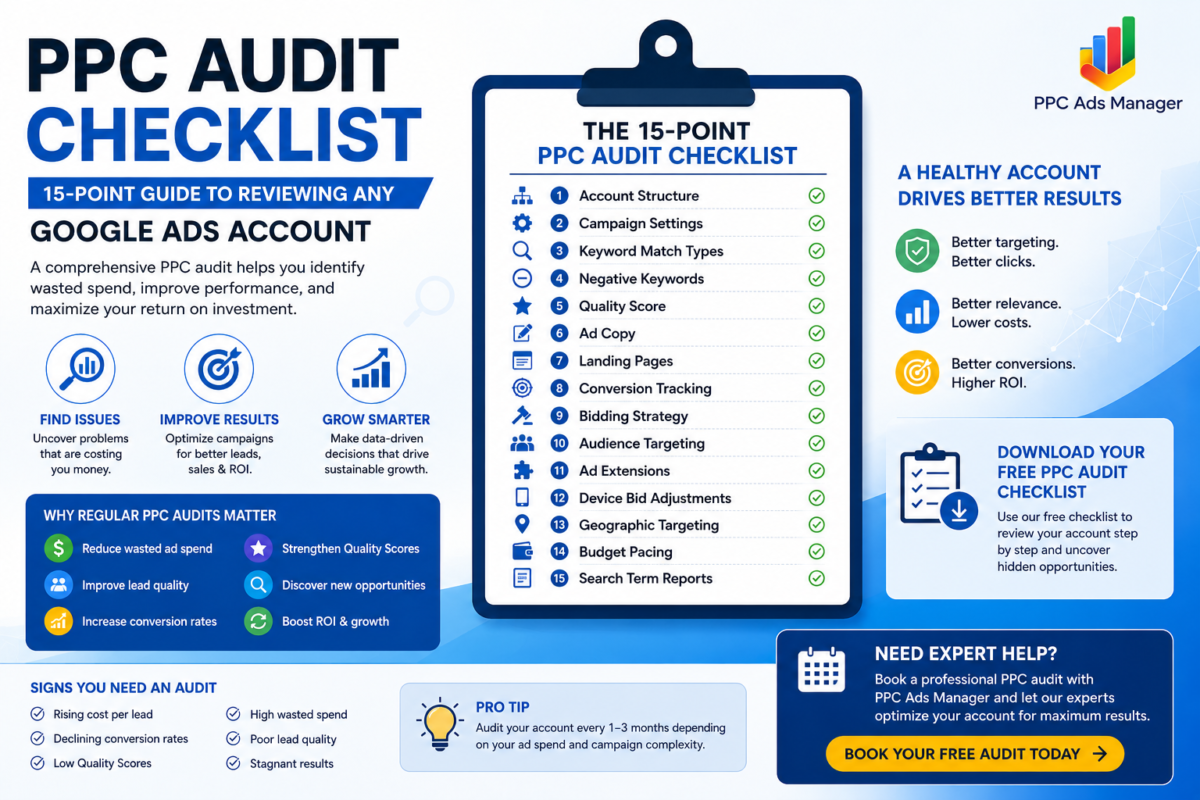
Whether you manage campaigns in-house or work with an agency, this 15-point PPC audit checklist will help you evaluate the health of any Google Ads account and identify areas for improvement.
Why Regular PPC Audits Matter
A PPC audit is more than a routine check-up.
It provides a structured framework for evaluating account performance and ensuring that campaigns align with business objectives.
Regular audits help businesses:
- Reduce wasted ad spend
- Improve lead quality
- Increase conversion rates
- Strengthen Quality Scores
- Discover new keyword opportunities
- Enhance audience targeting
- Improve return on investment
- Stay competitive within the market
Many businesses continue spending thousands on advertising without fully understanding where inefficiencies exist. A systematic audit can often reveal simple adjustments that generate significant improvements.
How Often Should You Audit Your Google Ads Account?
The frequency of audits depends on account size and advertising spend.
Small Accounts
Businesses spending modest budgets should conduct a detailed audit every quarter.
Medium-Sized Accounts
Monthly reviews are recommended to ensure campaigns remain aligned with objectives.
Large Accounts
High-spending advertisers should perform comprehensive audits monthly while monitoring key metrics weekly.
The larger the budget, the more important regular auditing becomes.
The Ultimate 15-Point PPC Audit Checklist
1. Review Account Structure
Account structure is the foundation of successful PPC management.
Poorly organised accounts create confusion, reduce relevance, and make optimisation more difficult.
Evaluate:
- Campaign organisation
- Ad group segmentation
- Naming conventions
- Product or service categorisation
- Geographic segmentation
A well-structured account makes management easier and improves overall performance.
2. Examine Campaign Settings
Incorrect campaign settings can significantly impact results.
Review:
- Campaign objectives
- Location settings
- Language targeting
- Ad scheduling
- Network settings
Many advertisers unknowingly target irrelevant audiences because of improper campaign configurations.
Ensuring settings align with business goals is a critical audit step.
3. Evaluate Keyword Match Types
Keyword match types influence how broadly or narrowly your ads are triggered.
Review the balance between:
- Broad Match
- Phrase Match
- Exact Match
Overreliance on broad keywords can generate excessive irrelevant traffic, while overly restrictive targeting may limit growth opportunities.
The ideal strategy balances reach and relevance.
4. Audit Negative Keywords
Negative keywords are among the most powerful tools for controlling advertising spend.
Without a robust negative keyword strategy, campaigns frequently appear for irrelevant searches.
Review:
- Existing negative keyword lists
- Search term reports
- Shared negative keyword libraries
- Competitor terms where appropriate
Effective negative keyword management often delivers immediate efficiency improvements.
5. Assess Quality Score
Quality Score remains one of Google’s most important performance indicators.
A low Quality Score often leads to:
- Higher cost per click
- Lower ad positions
- Reduced visibility
Review the three primary components:
- Expected click-through rate
- Ad relevance
- Landing page experience
Improving Quality Score can lower costs while increasing visibility.
6. Review Ad Copy Performance
Your advertisements are often the first interaction prospects have with your business.
Evaluate:
- Headlines
- Descriptions
- Calls to action
- Value propositions
- Click-through rates
Ask yourself:
Would this advertisement stand out among competitors?
Compelling ad copy can significantly influence campaign performance.
7. Check Landing Page Relevance
Even exceptional advertisements cannot compensate for poor landing pages.
Evaluate:
- Message consistency
- Mobile responsiveness
- Loading speed
- User experience
- Conversion elements
The transition from advertisement to landing page should feel seamless.
Any disconnect can reduce conversion rates.
8. Verify Conversion Tracking
Accurate conversion tracking is essential for informed decision-making.
Unfortunately, tracking issues are among the most common problems discovered during audits.
Review:
- Form submissions
- Phone call tracking
- Purchase tracking
- Lead tracking
- Analytics integrations
Without reliable tracking, optimisation becomes largely guesswork.
9. Assess Bidding Strategy
Google offers a variety of bidding strategies, each suited to different objectives.
Review whether your strategy aligns with campaign goals.
Common bidding options include:
- Maximise Clicks
- Maximise Conversions
- Target CPA
- Target ROAS
- Manual CPC
An inappropriate bidding strategy can significantly limit performance.
10. Analyse Audience Targeting
Audience targeting has evolved dramatically through machine learning and artificial intelligence.
Review:
- Remarketing audiences
- Customer Match audiences
- In-market audiences
- Affinity audiences
- Audience signals
Effective audience segmentation often improves conversion rates while reducing acquisition costs.
11. Review Ad Assets and Extensions
Ad assets provide additional information and increase advertisement visibility.
Review:
- Sitelinks
- Call extensions
- Callout extensions
- Structured snippets
- Location assets
- Lead form extensions
Well-utilised ad assets improve click-through rates and enhance user experience.
12. Evaluate Device Performance
Users behave differently across devices.
Analyse performance for:
- Mobile devices
- Desktop devices
- Tablets
Review metrics including:
- Conversion rates
- Cost per acquisition
- Click-through rates
Device-level insights may reveal opportunities for bid adjustments.
13. Audit Geographic Targeting
Location targeting should reflect actual business opportunities.
Review:
- Geographic performance reports
- Conversion rates by location
- Cost per conversion by region
- Excluded locations
Businesses often discover that specific locations significantly outperform others.
This information can help optimise budget allocation.
14. Review Budget Pacing
Budget management is frequently overlooked.
Evaluate:
- Daily budget allocation
- Campaign spending trends
- Budget limitations
- Impression share lost due to budget constraints
A campaign that consistently runs out of budget may miss valuable opportunities.
Conversely, overfunded campaigns may waste resources.
15. Analyse Search Term Reports
Search term reports provide invaluable insight into how users actually interact with your advertisements.
Review:
- High-performing search queries
- Irrelevant search terms
- New keyword opportunities
- Negative keyword opportunities
This report often reveals hidden optimisation opportunities that can significantly improve account efficiency.
Common PPC Audit Mistakes
Many advertisers focus exclusively on performance metrics while overlooking strategic issues.
Common mistakes include:
- Ignoring conversion tracking problems
- Failing to review search terms regularly
- Neglecting landing page optimisation
- Overlooking audience segmentation
- Using outdated bidding strategies
- Focusing solely on click costs
A successful audit evaluates the entire advertising ecosystem rather than isolated metrics.
What to Do After Completing Your Audit
An audit only creates value when findings are translated into action.
After completing your review:
- Prioritise high-impact opportunities.
- Address tracking issues immediately.
- Improve account structure where necessary.
- Update negative keyword lists.
- Optimise advertisements and landing pages.
- Refine audience targeting.
- Review bidding strategies.
- Monitor results closely.
Incremental improvements often generate substantial gains over time.
Signs Your Google Ads Account Needs an Audit
If you notice any of the following, an audit should become a priority:
- Rising cost per lead
- Declining conversion rates
- Increasing cost per click
- Lower Quality Scores
- Reduced impression share
- Stagnant growth
- Poor lead quality
- Inconsistent performance
These indicators often signal underlying issues that require attention.
Why Professional PPC Audits Deliver Better Results
While internal reviews are valuable, external audits often provide additional perspective.
Professional PPC specialists can identify:
- Structural inefficiencies
- Missed optimisation opportunities
- Tracking issues
- Competitive weaknesses
- Advanced growth opportunities
Fresh eyes frequently uncover problems that account managers may overlook.
About PPC Ads Manager
At PPC Ads Manager, we specialise in helping businesses maximise the value of every advertising pound, dollar, or rupee spent on Google Ads.
Our team conducts detailed PPC audits that go beyond surface-level metrics. We analyse account structure, keyword strategy, audience targeting, conversion tracking, landing page performance, bidding strategies, and overall account efficiency.
Our objective is simple: identify opportunities that improve lead quality, increase conversions, and generate stronger returns on advertising investment.
Whether you manage campaigns internally or work with another agency, a professional audit can provide valuable insights into how your account can perform better.
Download Your Free PPC Audit Checklist
A structured audit framework makes it easier to identify inefficiencies and opportunities before they impact performance.
Download our free PPC Audit Checklist and use it to review your Google Ads account step by step.
The checklist is designed for business owners, marketers, and advertisers who want a practical framework for evaluating campaign performance and uncovering optimisation opportunities.
Need Expert Help Reviewing Your Google Ads Account?
If your campaigns are not generating the results you expected, the problem may not be your budget.
It may be hidden within your account structure, keyword strategy, targeting settings, conversion tracking, or landing pages.
At PPC Ads Manager, we conduct comprehensive Google Ads audits designed to uncover wasted spend, improve efficiency, and maximise return on investment.
Book a professional PPC audit today and discover how your campaigns can generate better leads, stronger conversions, and more profitable growth.
Frequently Asked Questions
What is a PPC audit?
A PPC audit is a comprehensive review of a Google Ads account designed to identify inefficiencies, optimisation opportunities, and performance issues.
How often should I audit my Google Ads account?
Most businesses should conduct a detailed audit every one to three months depending on account size and advertising spend.
What is the most important part of a PPC audit?
Conversion tracking is often the most important element because inaccurate data affects every optimisation decision.
Can a PPC audit reduce advertising costs?
Yes. Audits frequently identify wasted spend, irrelevant traffic, and inefficient bidding strategies that can be corrected.
Why are negative keywords important?
Negative keywords prevent advertisements from appearing for irrelevant searches, improving efficiency and lead quality.
Does Quality Score still matter in 2026?
Yes. Quality Score continues to influence ad rank, cost per click, and overall campaign efficiency.
Should small businesses conduct PPC audits?
Absolutely. Even modest advertising budgets benefit from regular optimisation and performance reviews.
Is it worth hiring a professional PPC auditor?
Professional audits often uncover opportunities that internal teams overlook, making them a valuable investment for many businesses.
About PPC Ads Manager
At PPC Ads Manager, we believe paid advertising should do one thing above everything else—help businesses grow profitably.
I’ve spoken with business owners who spent months, and sometimes years, investing in advertising without being able to answer a simple question: “Which campaigns are actually making us money?” Most weren’t lacking budget. They were lacking clarity.
That’s why PPC Ads Manager was created.
We help businesses turn advertising spend into measurable business growth through strategic Google Ads management, Meta advertising, Performance Max campaigns, conversion tracking, remarketing, and performance analytics. Every campaign we build starts with one question: What does success look like for your business?
For some businesses, it’s generating more qualified leads. For others, it’s increasing online sales, lowering acquisition costs, improving return on ad spend, or scaling into new markets. Our job is to build advertising systems that support those goals and continuously improve them over time.
Over the years, we’ve worked with businesses across hospitality, eCommerce, healthcare, IT, solar energy, and local service industries. While every business is different, one thing remains the same: we focus on the metrics that actually matter and make decisions based on data, not assumptions.
We’re not interested in vanity metrics. We’re interested in helping businesses make smarter advertising investments and achieve sustainable, long-term growth.
Meet the Founder
Hi, I’m Navneet Singh Chauhan, Founder of PPC Ads Manager.
I’ve spent more than 16 years in digital marketing and over a decade managing paid advertising campaigns across Google Ads, Meta Ads, LinkedIn Ads, analytics, and conversion optimization.
Throughout my career, I’ve had the opportunity to work with startups, growing businesses, and global brands across multiple industries and markets. I’ve managed annual Google Ads budgets exceeding $7.8 million and worked on campaigns for luxury hospitality brands, eCommerce businesses, healthcare providers, IT companies, and solar energy organizations.
My experience has taught me that successful advertising isn’t about spending more money or chasing every new marketing trend. It’s about understanding your customers, asking the right questions, measuring what matters, and consistently improving performance.
I founded PPC Ads Manager because I saw too many businesses receiving complicated reports, vague recommendations, and campaigns that looked busy on paper but didn’t contribute meaningfully to business growth. I wanted to create a more transparent and practical approach to paid advertising—one that focuses on lead quality, profitability, and long-term results.
Everything we recommend on this website comes from real-world experience, continuous learning, and lessons gained from managing campaigns across different industries and markets.
Our Philosophy: The 3Ts
PPC Ads Manager is built on three principles: Transparency, Tenacity, and Transformation. Together, these principles help us earn something that cannot be claimed but must be earned every day—trust.
Transparency
No black boxes. No vanity metrics. No surprises.
You should always know where your advertising budget is being spent, what’s working, what isn’t, and why certain decisions are being made. We believe in full account ownership, honest reporting, clear communication, and educating our clients so they can make informed business decisions with confidence.
Tenacity
We don’t set and forget campaigns.
Digital advertising changes constantly. Competitors adjust their strategies, customer behavior evolves, and platforms update their algorithms. Some campaigns work immediately. Most don’t.
That’s why we continuously test, optimize, analyze, and refine our campaigns. We approach challenges with curiosity, accountability, and a relentless commitment to improving performance because good results rarely happen by accident.
Transformation
Advertising should create measurable business growth.
A campaign that generates clicks but doesn’t improve revenue isn’t a win. We measure success by the quality of leads, profitability, customer acquisition efficiency, and whether advertising is helping your business grow predictably.
Our goal isn’t simply to manage ads. It’s to help businesses turn marketing spend into growth systems that can scale.
The Outcome: Trust
Our internal mantra is simple:
Be transparent in communication, tenacious in execution, and transformational in impact.
Clients trust us because we’re honest about reality, relentless in our pursuit of better performance, and focused on outcomes that genuinely move businesses forward.
At PPC Ads Manager, we’re not here to be another advertising vendor. We’re here to be a long-term growth partner that helps businesses invest in advertising with confidence and build campaigns that deliver real, measurable results.
16+ Years of Digital Marketing Experience | 10+ Years of Paid Media Expertise | $7.8M+ Annual Google Ads Budget Managed | Experience Across Hospitality, eCommerce, Healthcare, IT, Solar & Local Businesses