Digital advertising has never been more powerful or more competitive than it is today. Businesses have access to advanced targeting capabilities, sophisticated automation tools, artificial intelligence driven bidding systems, and unprecedented amounts of consumer data. Yet despite these technological advancements, one question continues to dominate discussions among marketers and business owners:
Should you invest in Google Ads or Meta Ads?
At first glance, the answer appears simple. Both platforms are industry leaders. Both can generate leads, sales, and brand awareness. Both offer detailed reporting and extensive audience targeting options.
However, the reality is far more nuanced.
The platform that delivers exceptional results for one business may underperform for another. A local law firm has vastly different advertising needs than a fashion brand. A B2B software company operates differently from an e-commerce retailer. Understanding these distinctions is essential before deciding where to allocate your advertising budget.
In 2026, success is no longer about choosing the most popular advertising platform. It is about choosing the platform that aligns with your customers’ behaviour, buying journey, and business objectives.
This guide explores the differences between Google Ads and Meta Ads, compares their strengths and weaknesses, examines costs and targeting capabilities, and helps determine which platform is best suited to your business.
Understanding the Core Difference
Before discussing budgets, ad formats, or return on investment, it is important to understand the fundamental distinction between these platforms.
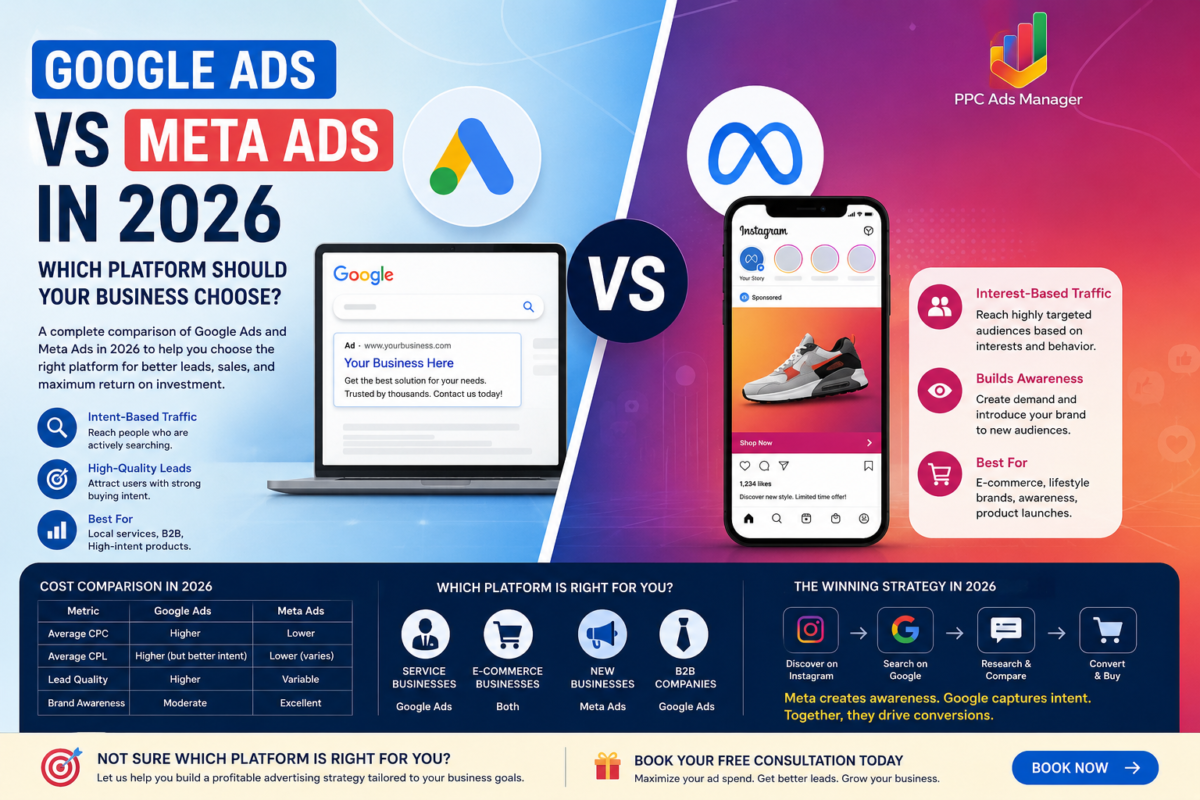
Google Ads is intent-based advertising.
Meta Ads is interest-based advertising.
This single difference influences nearly every aspect of campaign performance.
Google Ads: Capturing Existing Demand
When people use Google, they are typically searching for something specific.
They may be looking for:
- A digital marketing agency
- A nearby dentist
- Accounting software
- Home renovation services
- Running shoes
- Personal injury lawyers
In each of these examples, the user has already identified a need.
Google Ads allows businesses to appear at the precise moment a potential customer is actively searching for a solution.
This is why Google is often regarded as one of the most effective lead generation platforms in the world.
The customer already has intent. The advertiser simply needs to present the right solution.
Meta Ads: Creating Demand
Meta Ads operates differently.
People browse Facebook and Instagram to consume content, engage with friends, watch videos, and discover new ideas.
They are usually not searching for products or services.
Instead, Meta identifies potential customers based on interests, behaviours, demographics, online activity, and engagement patterns.
The platform introduces products and services to audiences who may be interested, even if they have not actively searched for them.
Meta excels at creating demand, building awareness, and influencing purchasing decisions before consumers enter the research stage.
Understanding this distinction is critical because it explains why both platforms often perform differently across industries.
Google Ads vs Meta Ads: Quick Comparison
| Feature | Google Ads | Meta Ads |
|---|---|---|
| User Intent | Very High | Moderate |
| Lead Quality | High | Variable |
| Brand Awareness | Good | Excellent |
| Audience Discovery | Moderate | Excellent |
| Local Services | Excellent | Moderate |
| E-commerce | Strong | Strong |
| Visual Storytelling | Limited | Excellent |
| B2B Marketing | Excellent | Good |
| Customer Acquisition Speed | Faster | Slower |
| AI Automation | Advanced | Advanced |
Although comparison tables are useful, they only tell part of the story. To make an informed decision, businesses must understand where each platform truly shines.
When Google Ads Wins
Google Ads remains one of the most effective channels for businesses that rely on high-intent traffic.
Local Service Businesses
Imagine a homeowner discovers a leaking pipe at midnight.
They are unlikely to browse Instagram looking for plumbing advice.
Instead, they will immediately search:
“Emergency plumber near me”
This urgency creates one of Google’s greatest advantages.
Businesses such as plumbers, electricians, dentists, locksmiths, accountants, and legal firms often achieve outstanding results through Google because customers actively seek their services.
The platform places businesses directly in front of users who are ready to take action.
B2B Companies
Business buyers typically conduct extensive research before making purchasing decisions.
Decision makers frequently search for:
- CRM software
- Project management tools
- HR solutions
- Marketing agencies
- Cybersecurity providers
Google enables B2B companies to appear during this critical research phase, making it an essential channel for lead generation.
High Intent Products and Services
Products with established demand often perform exceptionally well through Google Ads.
Examples include:
- Insurance policies
- Educational courses
- Financial services
- Professional certifications
- Software subscriptions
These buyers already know what they need. Google helps connect them with relevant solutions.
Faster Conversions
Because users arrive with intent, Google campaigns frequently generate:
- Higher conversion rates
- Better lead quality
- Faster purchasing decisions
- Stronger return on investment
For many businesses, particularly service providers, Google serves as the foundation of a successful advertising strategy.
When Meta Ads Wins
While Google captures existing demand, Meta excels at introducing products and services to new audiences.
E-commerce Brands
Many consumers discover products through Instagram and Facebook before ever searching for them.
A visually compelling advertisement can generate interest instantly.
Fashion brands, beauty companies, fitness products, home décor businesses, and lifestyle brands often achieve exceptional results through Meta because the platform is designed for visual engagement.
Brand Awareness Campaigns
Meta’s ecosystem allows businesses to tell stories.
Brands can showcase:
- Product demonstrations
- Customer testimonials
- Behind-the-scenes content
- Educational videos
- Brand values
These formats create familiarity and trust over time.
New Product Launches
If customers do not know a product exists, they cannot search for it.
Meta solves this problem by introducing products to highly relevant audiences.
This makes the platform particularly valuable for startups and businesses launching innovative offerings.
Visual Industries
Industries that rely heavily on aesthetics frequently thrive on Meta.
Examples include:
- Fashion
- Beauty
- Interior design
- Travel
- Fitness
- Hospitality
- Luxury products
The platform’s visual nature allows businesses to inspire customers before they begin actively researching options.
Cost Comparison in 2026
One of the most common questions advertisers ask is:
Which platform is cheaper?
The answer depends on what metric you measure.
Cost Per Click
Meta generally offers lower cost per click figures compared to Google.
However, lower click costs do not automatically translate into higher profitability.
A person clicking a Google advertisement may already be ready to purchase.
A person clicking a Meta advertisement may simply be curious.
Therefore, evaluating campaigns solely on click costs can be misleading.
Cost Per Lead
Meta often generates leads at lower costs.
However, lead quality can vary significantly depending on targeting, creative quality, and offer strength.
Google frequently generates fewer leads but higher-intent prospects.
Businesses should focus on customer acquisition cost and return on investment rather than vanity metrics.
A lead costing ₹1,000 that becomes a long-term customer is often far more valuable than a lead costing ₹200 that never converts.
Audience Targeting Differences
Audience targeting has evolved significantly due to artificial intelligence and machine learning.
Google Ads Targeting
Google offers:
- Keyword targeting
- Search intent targeting
- In-market audiences
- Customer Match audiences
- Remarketing lists
- Performance Max audience signals
Google focuses primarily on what people are actively doing and searching for.
Meta Ads Targeting
Meta offers:
- Interest targeting
- Behaviour targeting
- Demographic targeting
- Custom audiences
- Lookalike audiences
- Advantage+ AI targeting
Meta excels at identifying potential customers who resemble existing buyers.
This makes it particularly effective for scaling campaigns.
Ad Format Differences
Advertising success often depends on the ability to communicate effectively through creative formats.
Google Ads Formats
Search Ads
Text advertisements displayed within search results remain Google’s most powerful lead generation format.
Shopping Ads
Shopping campaigns showcase products directly within search results, making them invaluable for e-commerce businesses.
Performance Max
Performance Max uses artificial intelligence to distribute advertisements across Search, YouTube, Maps, Gmail, Display, and Discover.
YouTube Ads
Video advertising through YouTube helps businesses build awareness and nurture prospects through educational content.
Meta Ads Formats
Image Ads
Simple yet highly effective for promoting products, offers, and services.
Video Ads
Video content remains one of the strongest performing formats across Facebook and Instagram.
Carousel Ads
Businesses can display multiple products, features, or benefits within a single advertisement.
Stories and Reels
Short-form content continues to dominate user engagement and provides excellent opportunities for brand visibility.
Which Platform Works Best for Different Business Types?
| Business Type | Recommended Platform |
|---|---|
| Law Firms | Google Ads |
| Accountants | Google Ads |
| Dentists | Google Ads |
| SaaS Companies | Google Ads |
| Home Services | Google Ads |
| Fashion Brands | Meta Ads |
| Fitness Brands | Meta Ads |
| Restaurants | Meta + Google |
| E-commerce Stores | Meta + Google |
| Real Estate | Meta + Google |
| Hospitality Businesses | Meta Ads |
| Luxury Products | Meta Ads |
The most successful advertisers understand that platform selection should be based on customer behaviour rather than personal preference.
Can You Run Both Platforms Together?
Absolutely.
In fact, many of the highest-performing businesses use both platforms simultaneously.
Consider a common customer journey.
A potential customer discovers a product through Instagram.
They become interested but do not purchase immediately.
Several days later, they search Google for reviews, comparisons, and pricing information.
Eventually, they complete the purchase.
Meta initiated awareness.
Google captured intent.
Both platforms contributed to the sale.
Modern consumers rarely follow linear paths to purchase. Businesses that leverage both platforms often experience stronger overall performance because they engage customers throughout multiple stages of the buying journey.
Recommended Budget Splits in 2026
While every business has unique requirements, the following budget allocations provide useful starting points.
Local Service Businesses
- Google Ads: 70%
- Meta Ads: 30%
E-commerce Brands
- Google Ads: 50%
- Meta Ads: 50%
New Businesses
- Google Ads: 40%
- Meta Ads: 60%
B2B Companies
- Google Ads: 80%
- Meta Ads: 20%
Established Consumer Brands
- Google Ads: 40%
- Meta Ads: 60%
These allocations should be adjusted based on performance data and business objectives.
The Impact of Artificial Intelligence on Advertising in 2026
Artificial intelligence has transformed digital advertising.
Google now relies heavily on automated bidding, Performance Max campaigns, and predictive audience modelling.
Meta has introduced increasingly sophisticated Advantage+ solutions that automate audience discovery, creative optimisation, and campaign management.
While automation has improved efficiency, it has not eliminated the need for strategy.
Successful campaigns still require:
- Strong positioning
- Effective messaging
- Quality creative assets
- Landing page optimisation
- Data interpretation
- Strategic oversight
Businesses that combine AI automation with human expertise often achieve the strongest results.
Final Verdict: Which Platform Should You Choose?
The answer depends entirely on your goals.
If customers are actively searching for your products or services, Google Ads often delivers the fastest route to qualified leads and conversions.
If your objective is to build awareness, generate interest, and introduce products to new audiences, Meta Ads frequently provides superior results.
However, framing the discussion as Google Ads versus Meta Ads may be the wrong approach.
The most successful businesses in 2026 understand that customers interact with multiple platforms before making purchasing decisions.
Rather than choosing one platform over another, businesses should focus on creating a unified strategy that supports the entire customer journey.
In many cases, the strongest results come from combining the strengths of both platforms.
About PPC Ads Manager
At PPC Ads Manager, we help businesses transform advertising budgets into measurable business growth.
Our expertise spans Google Ads, Meta Ads, conversion optimisation, audience targeting, remarketing, and performance marketing strategy. We believe successful advertising is not measured by clicks or impressions alone. It is measured by qualified leads, customer acquisition, revenue growth, and long-term profitability.
Every campaign we manage is built around data, strategic planning, continuous optimisation, and a deep understanding of customer behaviour. Whether you are a local service provider, an e-commerce business, or a growing company looking to scale, our goal is to help you maximise return on investment through intelligent paid advertising.
As digital marketing continues to evolve, we remain committed to delivering transparent, results-driven strategies that help businesses grow with confidence.
Ready to Make the Right Advertising Decision?
Choosing between Google Ads and Meta Ads can feel overwhelming, especially when every business has unique goals, audiences, and budget considerations.
The truth is that there is no universal solution.
What works for one company may not work for another.
That is why we take a strategic, data-driven approach to paid advertising.
If you are unsure whether Google Ads, Meta Ads, or a combination of both is the best fit for your business, we can help.
Our team will analyse your industry, competition, objectives, customer journey, and growth opportunities to create a tailored advertising strategy designed to maximise results.
Book your free consultation here at free google ads audit and discover how a smarter advertising strategy can generate better leads, increase conversions, and accelerate business growth.
About PPC Ads Manager
At PPC Ads Manager, we help businesses turn advertising budgets into measurable growth. Our approach goes beyond launching campaigns. We focus on understanding customer behaviour, identifying profitable opportunities, and building advertising strategies that generate sustainable returns.
From Google Search and Performance Max campaigns to Meta advertising and advanced remarketing strategies, we work with businesses across industries to improve lead quality, reduce acquisition costs, and maximise return on investment.
Our philosophy is simple. Every advertising decision should be supported by data, aligned with business objectives, and designed to create long term value. Whether you are a local service provider, an e-commerce brand, or a growing company looking to scale, our goal is to help you reach the right audience at the right time with the right message.
Meet the Founder
PPC Ads Manager was founded by a digital marketing professional with hands on experience managing performance marketing campaigns across multiple industries. Combining strategic thinking with practical execution, the focus has always been on delivering campaigns that contribute directly to business growth rather than vanity metrics.
With experience spanning Google Ads, Meta Ads, conversion optimisation, audience targeting, and performance analysis, the objective is to help businesses navigate an increasingly competitive digital landscape with confidence and clarity.
Every recommendation published on this website is based on real world advertising principles, industry best practices, and a commitment to continuous learning in an ever evolving digital environment.
Frequently Asked Questions
Is Google Ads better than Meta Ads in 2026?
Neither platform is universally better. The ideal choice depends on your business model, goals, and customer behaviour.
Which platform generates better leads?
Google Ads typically produces higher-intent leads, while Meta often generates greater lead volume.
Which platform is more affordable?
Meta generally offers lower click costs, but profitability depends on conversion rates and customer acquisition costs.
Is Meta Ads still effective after privacy updates?
Yes. Meta’s artificial intelligence capabilities continue to make the platform highly effective for many businesses.
Which platform is best for e-commerce?
Most e-commerce brands achieve the strongest results by combining Google Ads and Meta Ads.
Can small businesses use both platforms?
Absolutely. Even modest budgets can be allocated strategically across both platforms.
How much should I spend on paid advertising?
Budgets vary by industry, competition, and goals. Focus on return on investment rather than spending levels alone.
Will artificial intelligence replace PPC specialists?
No. AI improves automation, but human strategy, creativity, analysis, and decision-making remain essential for long-term success.
About PPC Ads Manager
At PPC Ads Manager, we believe paid advertising should do one thing above everything else—help businesses grow profitably.
I’ve spoken with business owners who spent months, and sometimes years, investing in advertising without being able to answer a simple question: “Which campaigns are actually making us money?” Most weren’t lacking budget. They were lacking clarity.
That’s why PPC Ads Manager was created.
We help businesses turn advertising spend into measurable business growth through strategic Google Ads management, Meta advertising, Performance Max campaigns, conversion tracking, remarketing, and performance analytics. Every campaign we build starts with one question: What does success look like for your business?
For some businesses, it’s generating more qualified leads. For others, it’s increasing online sales, lowering acquisition costs, improving return on ad spend, or scaling into new markets. Our job is to build advertising systems that support those goals and continuously improve them over time.
Over the years, we’ve worked with businesses across hospitality, eCommerce, healthcare, IT, solar energy, and local service industries. While every business is different, one thing remains the same: we focus on the metrics that actually matter and make decisions based on data, not assumptions.
We’re not interested in vanity metrics. We’re interested in helping businesses make smarter advertising investments and achieve sustainable, long-term growth.
Meet the Founder
Hi, I’m Navneet Singh Chauhan, Founder of PPC Ads Manager.
I’ve spent more than 16 years in digital marketing and over a decade managing paid advertising campaigns across Google Ads, Meta Ads, LinkedIn Ads, analytics, and conversion optimization.
Throughout my career, I’ve had the opportunity to work with startups, growing businesses, and global brands across multiple industries and markets. I’ve managed annual Google Ads budgets exceeding $7.8 million and worked on campaigns for luxury hospitality brands, eCommerce businesses, healthcare providers, IT companies, and solar energy organizations.
My experience has taught me that successful advertising isn’t about spending more money or chasing every new marketing trend. It’s about understanding your customers, asking the right questions, measuring what matters, and consistently improving performance.
I founded PPC Ads Manager because I saw too many businesses receiving complicated reports, vague recommendations, and campaigns that looked busy on paper but didn’t contribute meaningfully to business growth. I wanted to create a more transparent and practical approach to paid advertising—one that focuses on lead quality, profitability, and long-term results.
Everything we recommend on this website comes from real-world experience, continuous learning, and lessons gained from managing campaigns across different industries and markets.
Our Philosophy: The 3Ts
PPC Ads Manager is built on three principles: Transparency, Tenacity, and Transformation. Together, these principles help us earn something that cannot be claimed but must be earned every day—trust.
Transparency
No black boxes. No vanity metrics. No surprises.
You should always know where your advertising budget is being spent, what’s working, what isn’t, and why certain decisions are being made. We believe in full account ownership, honest reporting, clear communication, and educating our clients so they can make informed business decisions with confidence.
Tenacity
We don’t set and forget campaigns.
Digital advertising changes constantly. Competitors adjust their strategies, customer behavior evolves, and platforms update their algorithms. Some campaigns work immediately. Most don’t.
That’s why we continuously test, optimize, analyze, and refine our campaigns. We approach challenges with curiosity, accountability, and a relentless commitment to improving performance because good results rarely happen by accident.
Transformation
Advertising should create measurable business growth.
A campaign that generates clicks but doesn’t improve revenue isn’t a win. We measure success by the quality of leads, profitability, customer acquisition efficiency, and whether advertising is helping your business grow predictably.
Our goal isn’t simply to manage ads. It’s to help businesses turn marketing spend into growth systems that can scale.
The Outcome: Trust
Our internal mantra is simple:
Be transparent in communication, tenacious in execution, and transformational in impact.
Clients trust us because we’re honest about reality, relentless in our pursuit of better performance, and focused on outcomes that genuinely move businesses forward.
At PPC Ads Manager, we’re not here to be another advertising vendor. We’re here to be a long-term growth partner that helps businesses invest in advertising with confidence and build campaigns that deliver real, measurable results.
16+ Years of Digital Marketing Experience | 10+ Years of Paid Media Expertise | $7.8M+ Annual Google Ads Budget Managed | Experience Across Hospitality, eCommerce, Healthcare, IT, Solar & Local Businesses