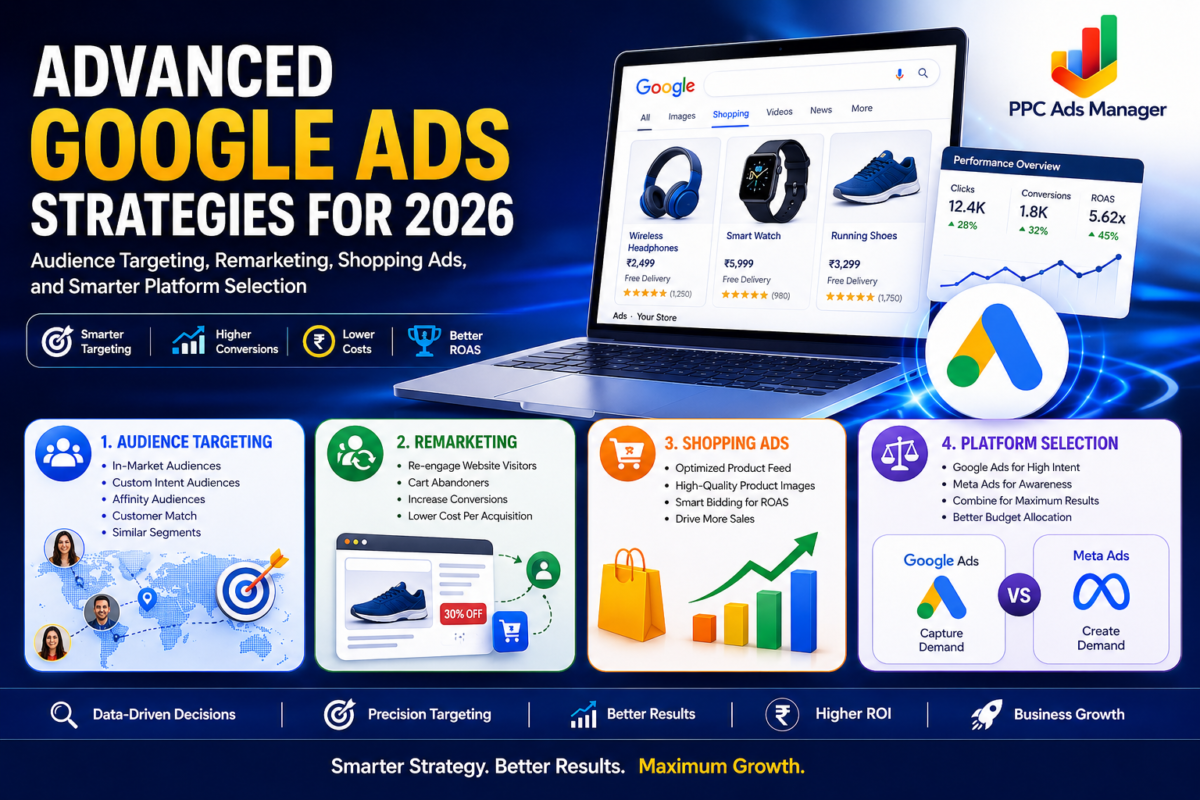
Google Ads continues to evolve at a remarkable pace. What once revolved primarily around keyword bidding has transformed into a sophisticated advertising ecosystem powered by audience signals, machine learning, automation, first-party data, and cross-channel campaign strategies.
For businesses investing in pay-per-click advertising, success in 2026 requires more than simply choosing keywords and writing ad copy. Advertisers must understand how to identify the right audiences, re-engage potential customers, maximise e-commerce performance through Shopping campaigns, and determine where Google Ads fits within their broader digital marketing strategy.
Whether you are a local business owner, an e-commerce retailer, a B2B company, or a growing enterprise, understanding these advanced Google Ads strategies can significantly improve campaign performance, reduce wasted spend, and increase return on investment.
This guide explores four of the most important Google Ads disciplines that every advertiser should master in 2026.
Why Google Ads Remains a Powerful Advertising Platform
Google processes billions of searches every day, making it one of the largest intent-driven advertising networks in the world.
Unlike many advertising channels that rely on interruption marketing, Google Ads reaches users at moments when they are actively searching for information, products, or services.
This creates opportunities to connect with prospects who already demonstrate buying intent.
Some of the primary benefits of Google Ads include:
- Immediate visibility
- Highly targeted traffic
- Measurable performance
- Flexible budgets
- Advanced audience targeting
- Powerful automation features
- Extensive conversion tracking
However, advertisers who rely solely on basic keyword targeting often struggle to achieve optimal results. Modern Google Ads success requires a deeper strategic approach.
The Shift from Keywords to Audience Intelligence
For many years, keyword targeting was considered the foundation of Google Ads.
Advertisers selected keywords, created advertisements, and competed for visibility in search results.
While keywords remain important, Google now places increasing emphasis on audience signals.
Keywords reveal what users are searching for.
Audiences reveal who those users are.
Understanding this distinction is crucial.
Consider two people searching for the same phrase:
“Business accounting software”
One user may be casually researching.
The other may be actively comparing vendors and preparing to purchase.
Audience data helps Google identify the difference.
By combining keywords with audience insights, advertisers can prioritise higher-value prospects and improve campaign efficiency.
Understanding Google Ads Audience Targeting
Audience targeting enables advertisers to reach users based on interests, behaviours, purchase intent, demographics, and previous interactions.
Rather than targeting everyone searching for a specific keyword, audience segmentation allows businesses to focus on the users most likely to convert.
In-Market Audiences
In-Market Audiences consist of users who are actively researching products or services and appear close to making a purchase decision.
Google identifies these users based on:
- Search behaviour
- Website visits
- Product comparisons
- Review consumption
- Shopping activity
These audiences often produce strong conversion rates because they target prospects already moving through the buying process.
Examples include:
- Business software buyers
- Insurance shoppers
- Travel planners
- Vehicle purchasers
- Property seekers
For lead generation campaigns and e-commerce stores, In-Market Audiences often represent one of the most valuable targeting options available.
Affinity Audiences
Affinity Audiences focus on long-term interests and lifestyle characteristics.
These users are grouped according to their ongoing behaviours and preferences.
Examples include:
- Technology enthusiasts
- Business professionals
- Fitness enthusiasts
- Luxury shoppers
- Travel lovers
Affinity Audiences excel in awareness campaigns where businesses want to introduce products or services to relevant groups before purchase intent emerges.
Custom Intent Audiences
Custom Intent Audiences provide significantly greater control.
Advertisers can create highly specific audiences using:
- Keywords
- Competitor websites
- Industry-related URLs
- Search behaviours
Google then identifies users displaying similar characteristics.
For specialised industries, Custom Intent Audiences often outperform broader predefined segments because they more accurately reflect ideal customer behaviour.
Customer Match
Customer Match uses first-party customer data to reconnect with existing contacts.
Businesses can upload:
- Email lists
- Customer databases
- Subscriber records
Google then matches these records with user accounts across its advertising ecosystem.
This approach is particularly effective for:
- Repeat purchases
- Upselling
- Cross-selling
- Retention campaigns
Similar Segments
Similar Segments help advertisers identify new prospects who resemble existing customers.
Google analyses behaviour patterns and expands audience reach while maintaining relevance.
For businesses focused on growth and customer acquisition, Similar Segments can provide valuable expansion opportunities.
Layering Audiences with Keywords
One of the most effective strategies in Google Ads involves combining audience targeting with keyword targeting.
For example:
Keyword:
- CRM software
Audience:
- In-Market Business Software Buyers
Rather than targeting everyone searching for CRM software, the campaign prioritises users actively evaluating software solutions.
This combination often leads to:
- Better lead quality
- Higher conversion rates
- Lower acquisition costs
- Stronger ROAS
Audience layering represents one of the simplest yet most powerful optimisation techniques available within Google Ads.
Remarketing: Converting Lost Opportunities into Customers
Most website visitors do not convert during their first interaction.
Users often:
- Research options
- Compare competitors
- Read reviews
- Delay purchasing decisions
Remarketing provides a way to reconnect with these prospects after they leave your website.
Instead of losing valuable traffic, businesses can continue engaging users throughout the decision-making process.
What Is Google Ads Remarketing?
Remarketing allows advertisers to show ads specifically to people who have already interacted with their brand.
These interactions may include:
- Website visits
- Product page views
- Shopping cart abandonment
- Form submissions
- Video engagement
Because these audiences are already familiar with the business, remarketing campaigns frequently achieve higher conversion rates than cold prospecting campaigns.
Popular Remarketing Strategies
Website Visitor Remarketing
Targets users who previously visited your website.
Cart Abandonment Campaigns
Focuses on users who added products to their cart but failed to complete checkout.
Product View Remarketing
Displays ads featuring products users previously viewed.
Customer Retention Campaigns
Encourages repeat purchases from existing customers.
RLSA Campaigns
Remarketing Lists for Search Ads allow businesses to modify bids and messaging for previous website visitors when they return to Google search.
Why Remarketing Matters in 2026
As customer acquisition costs continue increasing, remarketing has become one of the most cost-effective strategies available.
Benefits include:
- Higher conversion rates
- Lower cost per acquisition
- Improved brand recall
- Increased customer lifetime value
- Better overall advertising efficiency
For many advertisers, remarketing delivers some of the strongest returns within their Google Ads account.
Google Shopping Ads and E-Commerce Growth
For online retailers, Google Shopping campaigns have become essential.
Unlike traditional text advertisements, Shopping Ads provide visual product information before users click.
This includes:
- Product images
- Pricing
- Store information
- Reviews
- Promotions
As a result, shoppers arrive with greater purchasing intent.
How Google Shopping Ads Work
Shopping campaigns rely on product feed information rather than keyword selection.
Google uses product data from Merchant Center to determine when and where products appear.
This data includes:
- Product titles
- Descriptions
- Images
- GTINs
- Pricing
- Availability
The quality of this feed directly influences campaign performance.
Product Feed Optimisation
Feed optimisation remains one of the most overlooked aspects of Shopping campaign success.
Key optimisation areas include:
Product Titles
Strong titles contain:
- Brand
- Product type
- Key attributes
- Size
- Colour
- Model number
Product Descriptions
Descriptions should clearly explain product features and benefits.
Product Images
High-quality visuals significantly improve click-through rates.
Product Identifiers
Providing accurate GTINs and brand information helps Google categorise products correctly.
Accurate Pricing
Pricing discrepancies can lead to product disapprovals and reduced visibility.
Businesses that consistently optimise product feeds typically outperform competitors regardless of budget size.
Performance Max and Shopping Campaigns
Google’s Performance Max campaigns have transformed e-commerce advertising.
Instead of limiting ads to Shopping placements, Performance Max expands visibility across:
- Search
- Shopping
- YouTube
- Gmail
- Discover
- Display
By combining automation with audience signals and conversion data, Performance Max can help businesses scale efficiently when configured correctly.
Choosing Effective Bidding Strategies
Bidding plays a critical role in campaign profitability.
Google offers several options depending on business goals.
Manual CPC
Provides maximum control and is useful during testing phases.
Enhanced CPC
Balances automation with manual oversight.
Maximise Conversion Value
Focuses on generating the highest possible revenue.
Target ROAS
One of the most popular strategies for e-commerce advertisers.
Advertisers specify a desired return, and Google adjusts bids accordingly.
For example:
Spend: ₹10,000
Revenue: ₹50,000
ROAS: 500%
Google then attempts to achieve similar returns through automated bidding.
Google Ads vs Meta Ads: Understanding the Difference
Businesses frequently ask whether they should invest in Google Ads or Meta Ads.
The answer depends on objectives.
Both platforms serve important but distinct roles.
Google Ads Strengths
Google excels at capturing existing demand.
Users actively search for products, services, and solutions.
This creates high-intent traffic.
Google performs exceptionally well for:
- Local services
- Professional services
- B2B companies
- E-commerce stores
- Lead generation campaigns
Meta Ads Strengths
Meta platforms focus on demand generation.
Users are not actively searching.
Instead, advertisers interrupt browsing behaviour with targeted advertisements.
Meta performs particularly well for:
- Brand awareness
- Visual products
- Lifestyle brands
- Impulse purchases
- Community building
Which Platform Generates Better Leads?
For businesses dependent on immediate intent, Google Ads often produces stronger lead quality.
Users searching for:
- Roofing contractors
- Accountants
- Lawyers
- Medical services
- Marketing agencies
typically have immediate needs.
This intent frequently results in faster conversions.
Which Platform Is Better for E-Commerce?
The answer often depends on the customer journey.
Google Shopping campaigns excel at capturing consumers already searching for products.
Meta Ads excel at generating awareness and introducing products to new audiences.
Many successful e-commerce brands combine both platforms to maximise reach and profitability.
Building a Complete Google Ads Strategy
The strongest Google Ads accounts integrate multiple campaign types rather than relying on a single tactic.
A comprehensive strategy typically includes:
Search Campaigns
Capture active demand.
Audience Targeting
Improve efficiency and lead quality.
Remarketing Campaigns
Recover lost opportunities.
Shopping Campaigns
Drive e-commerce revenue.
Performance Max
Expand reach through automation.
Conversion Tracking
Measure results accurately.
When these components work together, advertisers create a marketing ecosystem that continually identifies, nurtures, and converts prospects.
Common Mistakes Advertisers Should Avoid
Even experienced advertisers make mistakes that limit performance.
Common issues include:
- Ignoring audience data
- Poor conversion tracking
- Weak product feeds
- Overly broad targeting
- Insufficient remarketing efforts
- Neglecting campaign segmentation
- Failing to analyse search terms
- Relying entirely on automation
Avoiding these mistakes can significantly improve campaign outcomes.
Final Thoughts
Google Ads in 2026 is no longer simply about choosing keywords and setting bids. The platform has evolved into an intelligent advertising ecosystem driven by audience insights, machine learning, first-party data, and advanced automation.
Businesses that understand audience targeting can reach more qualified prospects. Those that implement remarketing can recover lost opportunities. E-commerce brands that optimise Shopping campaigns can increase revenue and improve ROAS. Companies that understand the relationship between Google Ads and Meta Ads can allocate budgets more effectively.
Success comes from combining these strategies into a cohesive framework that attracts, nurtures, and converts customers throughout the buying journey.
Whether your goal is generating leads, growing an online store, increasing brand visibility, or scaling revenue, mastering these advanced Google Ads strategies can create a significant competitive advantage in an increasingly crowded digital marketplace.
Ready to Improve Your Google Ads Performance?
If your campaigns are generating clicks but not delivering the results you expect, our team can help. We will analyse your audience targeting, remarketing strategy, Shopping campaigns, bidding structure, and conversion tracking to uncover opportunities for growth. Request a free campaign review at Free google ads audit and discover how smarter Google Ads management can help your business generate more leads, more sales, and better returns on every advertising dollar.
Frequently Asked Questions
1. What is the most effective Google Ads strategy in 2026?
The most effective Google Ads strategy combines keyword targeting, audience targeting, remarketing, conversion tracking, and automated bidding. Businesses that integrate these elements typically achieve better lead quality, lower acquisition costs, and stronger return on ad spend than those relying solely on keywords.
2. Is audience targeting more important than keyword targeting?
Neither is more important on its own. Keywords reveal what users are searching for, while audience targeting helps identify who those users are. The highest-performing campaigns use both together to improve relevance and conversion rates.
3. What are In-Market Audiences in Google Ads?
In-Market Audiences consist of users actively researching products or services and showing signs of purchase intent. Google identifies these users based on their search behaviour, browsing activity, and online engagement patterns.
4. How does remarketing improve campaign performance?
Remarketing allows businesses to reconnect with users who have previously visited their website or interacted with their brand. Since these users already know the business, remarketing campaigns often generate higher conversion rates and lower cost per acquisition.
5. Are Google Shopping Ads worth it for e-commerce businesses?
Yes. Google Shopping Ads are among the most effective advertising formats for online stores because they display product images, pricing, reviews, and store information directly in search results. This attracts highly qualified traffic with strong purchase intent.
6. What is the difference between Standard Shopping and Performance Max?
Standard Shopping campaigns provide greater control over bidding and product segmentation. Performance Max uses automation to distribute ads across Google’s entire network, including Search, Shopping, YouTube, Gmail, Discover, and Display placements.
7. What is a good ROAS for Google Shopping campaigns?
A good ROAS depends on your industry, profit margins, and business goals. Many e-commerce businesses aim for a ROAS between 300% and 600%, although profitable benchmarks vary significantly across sectors.
8. Should small businesses use Google Ads or Meta Ads?
It depends on the objective. Google Ads is often better for capturing high-intent prospects actively searching for products or services, while Meta Ads excel at creating awareness and reaching new audiences through visual advertising.
About PPC Ads Manager
At PPC Ads Manager, we believe paid advertising should do one thing above everything else—help businesses grow profitably.
I’ve spoken with business owners who spent months, and sometimes years, investing in advertising without being able to answer a simple question: “Which campaigns are actually making us money?” Most weren’t lacking budget. They were lacking clarity.
That’s why PPC Ads Manager was created.
We help businesses turn advertising spend into measurable business growth through strategic Google Ads management, Meta advertising, Performance Max campaigns, conversion tracking, remarketing, and performance analytics. Every campaign we build starts with one question: What does success look like for your business?
For some businesses, it’s generating more qualified leads. For others, it’s increasing online sales, lowering acquisition costs, improving return on ad spend, or scaling into new markets. Our job is to build advertising systems that support those goals and continuously improve them over time.
Over the years, we’ve worked with businesses across hospitality, eCommerce, healthcare, IT, solar energy, and local service industries. While every business is different, one thing remains the same: we focus on the metrics that actually matter and make decisions based on data, not assumptions.
We’re not interested in vanity metrics. We’re interested in helping businesses make smarter advertising investments and achieve sustainable, long-term growth.
Meet the Founder
Hi, I’m Navneet Singh Chauhan, Founder of PPC Ads Manager.
I’ve spent more than 16 years in digital marketing and over a decade managing paid advertising campaigns across Google Ads, Meta Ads, LinkedIn Ads, analytics, and conversion optimization.
Throughout my career, I’ve had the opportunity to work with startups, growing businesses, and global brands across multiple industries and markets. I’ve managed annual Google Ads budgets exceeding $7.8 million and worked on campaigns for luxury hospitality brands, eCommerce businesses, healthcare providers, IT companies, and solar energy organizations.
My experience has taught me that successful advertising isn’t about spending more money or chasing every new marketing trend. It’s about understanding your customers, asking the right questions, measuring what matters, and consistently improving performance.
I founded PPC Ads Manager because I saw too many businesses receiving complicated reports, vague recommendations, and campaigns that looked busy on paper but didn’t contribute meaningfully to business growth. I wanted to create a more transparent and practical approach to paid advertising—one that focuses on lead quality, profitability, and long-term results.
Everything we recommend on this website comes from real-world experience, continuous learning, and lessons gained from managing campaigns across different industries and markets.
Our Philosophy: The 3Ts
PPC Ads Manager is built on three principles: Transparency, Tenacity, and Transformation. Together, these principles help us earn something that cannot be claimed but must be earned every day—trust.
Transparency
No black boxes. No vanity metrics. No surprises.
You should always know where your advertising budget is being spent, what’s working, what isn’t, and why certain decisions are being made. We believe in full account ownership, honest reporting, clear communication, and educating our clients so they can make informed business decisions with confidence.
Tenacity
We don’t set and forget campaigns.
Digital advertising changes constantly. Competitors adjust their strategies, customer behavior evolves, and platforms update their algorithms. Some campaigns work immediately. Most don’t.
That’s why we continuously test, optimize, analyze, and refine our campaigns. We approach challenges with curiosity, accountability, and a relentless commitment to improving performance because good results rarely happen by accident.
Transformation
Advertising should create measurable business growth.
A campaign that generates clicks but doesn’t improve revenue isn’t a win. We measure success by the quality of leads, profitability, customer acquisition efficiency, and whether advertising is helping your business grow predictably.
Our goal isn’t simply to manage ads. It’s to help businesses turn marketing spend into growth systems that can scale.
The Outcome: Trust
Our internal mantra is simple:
Be transparent in communication, tenacious in execution, and transformational in impact.
Clients trust us because we’re honest about reality, relentless in our pursuit of better performance, and focused on outcomes that genuinely move businesses forward.
At PPC Ads Manager, we’re not here to be another advertising vendor. We’re here to be a long-term growth partner that helps businesses invest in advertising with confidence and build campaigns that deliver real, measurable results.
16+ Years of Digital Marketing Experience | 10+ Years of Paid Media Expertise | $7.8M+ Annual Google Ads Budget Managed | Experience Across Hospitality, eCommerce, Healthcare, IT, Solar & Local Businesses