Human-written SEO blog content still outperforms purely AI-generated content in 2026 because search engines prioritize expertise, credibility, and original insight over volume. While AI tools produce content faster and cheaper, ranking stability depends on depth, experience, and authority signals that automation alone cannot replicate.
This is not about emotion. It’s about how search engines evaluate quality today.
If your business depends on organic traffic, you need to understand the difference clearly.
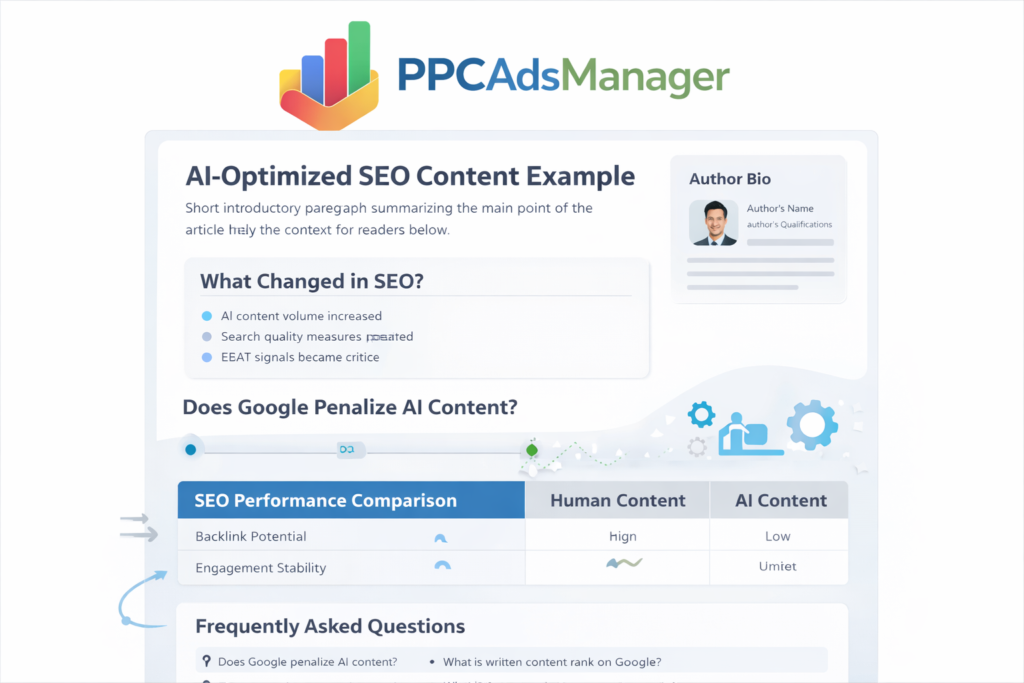
What Changed in SEO Between 2023 and 2026?
Three major shifts reshaped content ranking:
- AI content volume exploded.
- Search engines refined quality detection systems.
- EEAT moved from theory to measurable signals.
Search results became flooded with similar AI-written articles. Many followed identical structures, reused public data, and lacked original analysis.
Search engines responded by prioritizing:
- Demonstrated experience
- Author credibility
- Clear topic depth
- Unique data or frameworks
- Engagement signals
The result? Generic AI content started flattening in competitive niches.
Does Google Penalize AI Content?
No. Search engines do not penalize content simply because AI helped create it.
They penalize low-value content.
That distinction matters.
Here’s the reality:
| Scenario | Likely Outcome |
| Fully automated, unedited AI blogs | Short-term indexing, weak long-term ranking |
| AI-assisted + expert-reviewed content | Stable ranking potential |
| Expert-written content with real examples | Higher authority and backlink probability |
Quality is the deciding factor.
Why Human-Written SEO Blog Content Performs Better
1. Real Experience Signals
Human writers can include:
- Case studies
- Performance benchmarks
- Client challenges
- Tactical decision-making insights
AI can summarize common advice. It cannot genuinely describe lived experience.
Example 1
AI content: “Optimize landing pages for conversions.”
Human content: “Reducing form fields from 7 to 4 increased conversion rate by 22% in a B2B SaaS campaign.”
Example 2
AI content: “Use long-tail keywords.”
Human content: “Targeting ‘enterprise CRM implementation cost’ reduced CPL by 31% compared to broad CRM keywords.”
Specificity builds trust.
2. Contextual Judgment
AI models average patterns from existing content. They do not evaluate risk, compliance, or business trade-offs.
Human strategists understand nuance.
For example:
- In finance, compliance language matters.
- In healthcare, medical accuracy matters.
- In B2B IT, technical precision affects credibility.
Search engines increasingly evaluate topical depth and coherence across a site.
Humans build that ecosystem better.
3. Original Frameworks and Insights
AI rarely invents new strategic models.
Human experts create:
- New methodologies
- Custom frameworks
- Opinionated industry analysis
Original thinking attracts backlinks.
Backlinks remain one of the strongest ranking factors globally.
Where AI-Generated Content Fails in Competitive Niches
AI-generated content typically fails in three areas:
- Depth
- Differentiation
- Authority positioning
Weak Depth
AI content often stays surface-level because it synthesizes common public information.
Lack of Differentiation
Many AI blogs follow similar heading structures. This makes them indistinguishable.
Authority Gaps
AI articles often avoid strong opinions or nuanced arguments. This weakens brand positioning.
Real-World Scenario: Two Content Strategies Compared
Let’s compare two hypothetical SaaS companies in 2025–2026.
Company A – AI Mass Publishing
- 150 AI blogs in 6 months
- Generic advice topics
- No case studies
- Minimal author attribution
Result:
- Initial indexing spike
- Low dwell time
- Rankings decline after algorithm update
Company B – Expert-Led Publishing
- 3–4 in-depth blogs per month
- Data-backed examples
- Author credentials displayed
- Linked supporting content
Result:
- Slower start
- Strong backlinks
- Stable top 5 rankings
Consistency and credibility win long-term.
EEAT in 2026: What It Really Means
EEAT stands for:
- Experience
- Expertise
- Authoritativeness
- Trustworthiness
In 2026, this is reflected through:
- Author bios with credentials
- Industry references
- Accurate citations
- Transparent claims
- Clear editorial standards
Human-written SEO blog content naturally supports these elements.
AI content requires deliberate human oversight to meet them.
Best Practices for Using AI Without Hurting Rankings
AI is not the enemy. Misuse is.
Use AI for:
- Topic ideation
- Draft structuring
- Outline creation
- Data summarization
Do not rely on AI for:
- Thought leadership
- Industry predictions
- Compliance-sensitive content
- Case study storytelling
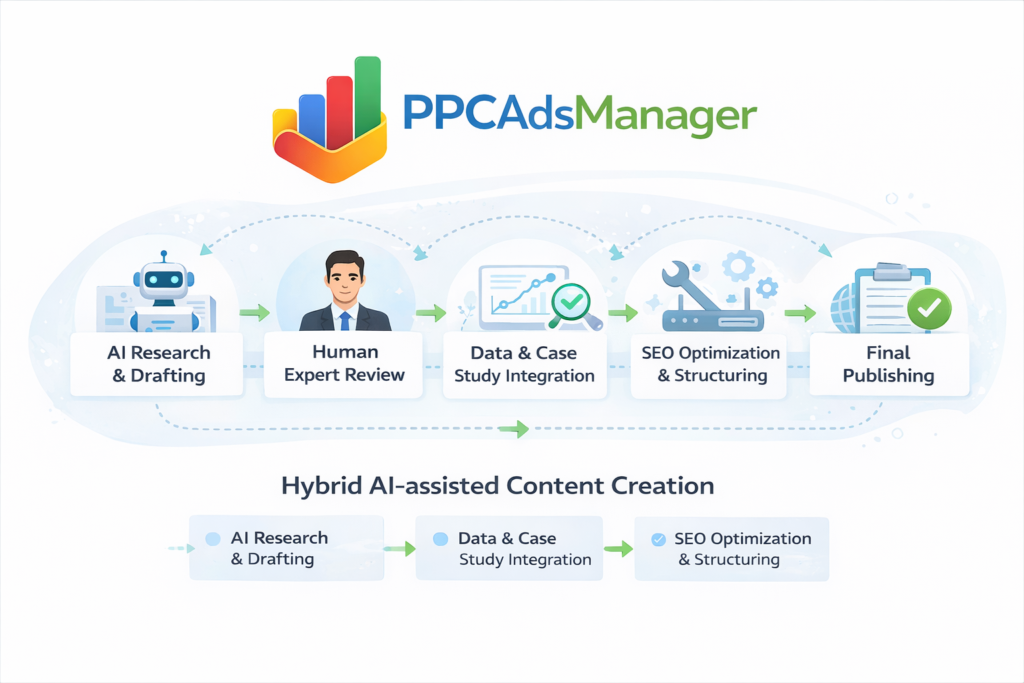
Best approach:
AI-assisted drafting → Expert review → Data enhancement → Brand voice refinement.
Common Mistakes Businesses Make
1. Publishing Without Editorial Review
Unedited AI content often contains:
- Generic phrasing
- Repetitive structure
- Minor factual inconsistencies
2. Ignoring Author Credibility
Publishing anonymous blogs weakens trust.
3. Focusing Only on Word Count
More words do not equal more value.
Depth and clarity matter more.
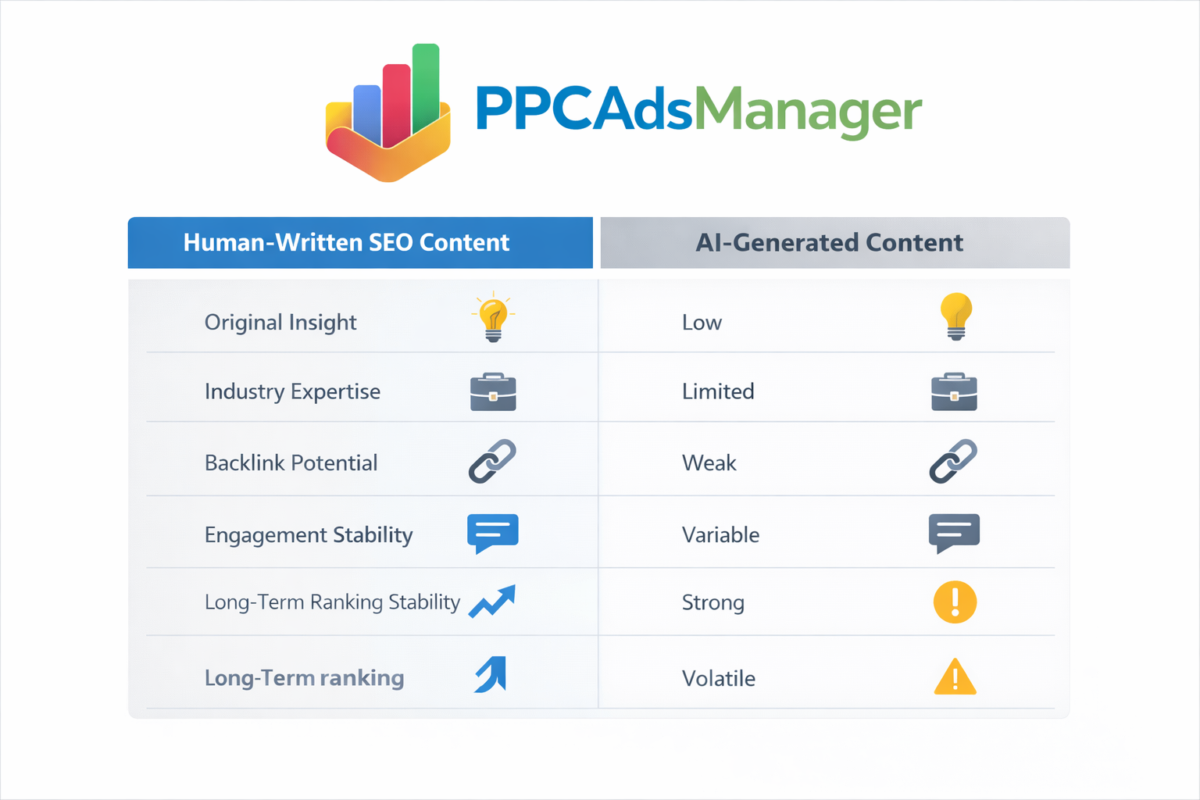
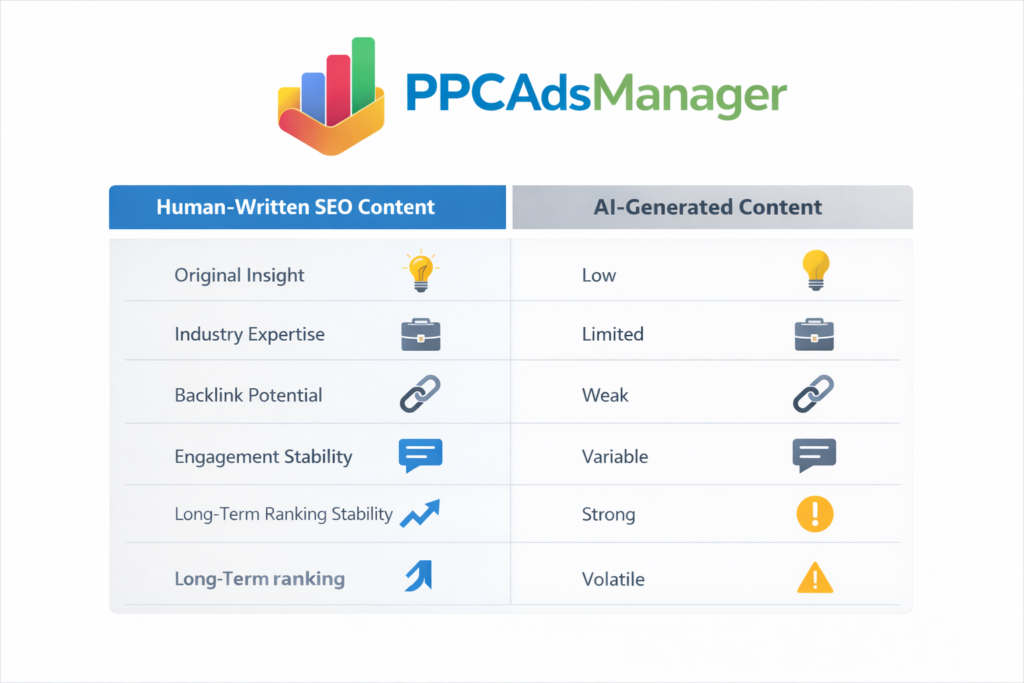
Performance Comparison: AI vs Human-Written Content
| Factor | Pure AI Content | Human-Written SEO Blog Content |
| Content Speed | High | Moderate |
| Original Insight | Low | High |
| Backlink Potential | Weak | Strong |
| Engagement Metrics | Inconsistent | More Stable |
| Long-Term Ranking Stability | Volatile | Stronger |
This table summarizes the practical difference businesses are observing globally.
When Human-Written Content Is Essential
You should prioritize human-written SEO blog content when:
- Competing in high-value B2B niches
- Targeting enterprise buyers
- Publishing compliance-heavy material
- Building brand authority
In low-competition informational niches, AI-assisted content may perform adequately.
But in competitive markets, expertise differentiates.
Strategic Implication for Businesses in 2026
The winning model is hybrid:
- AI for efficiency
- Human expertise for authority
- Data for credibility
- Structure for AI search extraction
This approach supports both traditional search rankings and AI-generated answer systems.
Businesses that automate blindly risk becoming interchangeable.
Businesses that combine efficiency with expertise build durable visibility.
Conclusion
Human-written SEO blog content still outranks AI-generated content in 2026 because search engines reward depth, credibility, and original expertise. AI is a powerful assistant, but not a substitute for industry experience.
The future of SEO is not human versus AI.
It is AI-assisted, expert-led strategy.
Brands that understand this balance will dominate organic search in the coming years.
FAQ’s
Does Google penalize AI-generated content in 2026?
No. Google does not penalize content simply because AI was used. It evaluates quality, relevance, and usefulness. Low-quality content whether AI or human-written may lose rankings.
Can AI-written blog content rank on Google?
Yes. AI-written content can rank if it is fact-checked, edited, and enhanced with original insights. Purely automated, generic content is less likely to sustain rankings in competitive niches.
Why does human-written SEO blog content perform better long-term?
Human-written content typically includes real experience, case studies, original analysis, and stronger EEAT signals. These factors improve trust, engagement, and backlink potential.
Is AI content bad for SEO?
AI content is not inherently bad. The problem arises when businesses publish unedited, repetitive, or surface-level material without adding expertise or value.
What is the best content strategy in 2026?
The most effective approach is hybrid:
- Use AI for drafting and research support.
- Use human expertise for analysis, positioning, and authority building.
Does EEAT affect AI-generated content rankings?
Yes. Content that demonstrates Experience, Expertise, Authoritativeness, and Trustworthiness tends to perform better. Human oversight strengthens these signals significantly.
Written by Rohith Bingi
Digital Marketing strategist