Introduction
Everyone wants Page 1 rankings.
Few understand what it actually takes.
The internet is flooded with AI-generated blog posts. Thousands of articles are published daily using the same tools, the same prompts, and the same surface-level information.
And most of them never rank.
Why?
Because Google does not reward content that sounds correct.
It rewards content that demonstrates depth, authority, and strategic intent.
Ranking on Page 1 today requires more than publishing volume. It requires structured, experience-driven, strategic SEO content for ranking on page 1, not generic AI output.
This guide explains what truly drives Page 1 rankings globally and why strategic SEO content for ranking on page 1 consistently outperforms automated mass production.
Why Most AI-Generated Content Fails to Rank
Let’s be honest.
AI tools can generate readable content quickly. But speed is not strategy.
Most AI-written blogs fail because they:
- Repeat common industry phrases
- Lack original insights
- Avoid specific data
- Mirror existing top-ranking content
- Do not demonstrate real experience
Search engines now evaluate:
- Topical depth
- Semantic coverage
- First-hand expertise
- Content differentiation
If your blog looks like 50 others in the SERP, it won’t replace them.
What “Strategic, AI-Free” Actually Means
AI-free does not mean refusing technology.
It means:
- Strategy comes first
- Expertise drives content
- AI supports structure (not replaces thinking)
- Human editing ensures originality
Strategic SEO content includes:
- Intent analysis before writing
- SERP structure review
- Competitor gap analysis
- Internal linking planning
- Authority signal integration
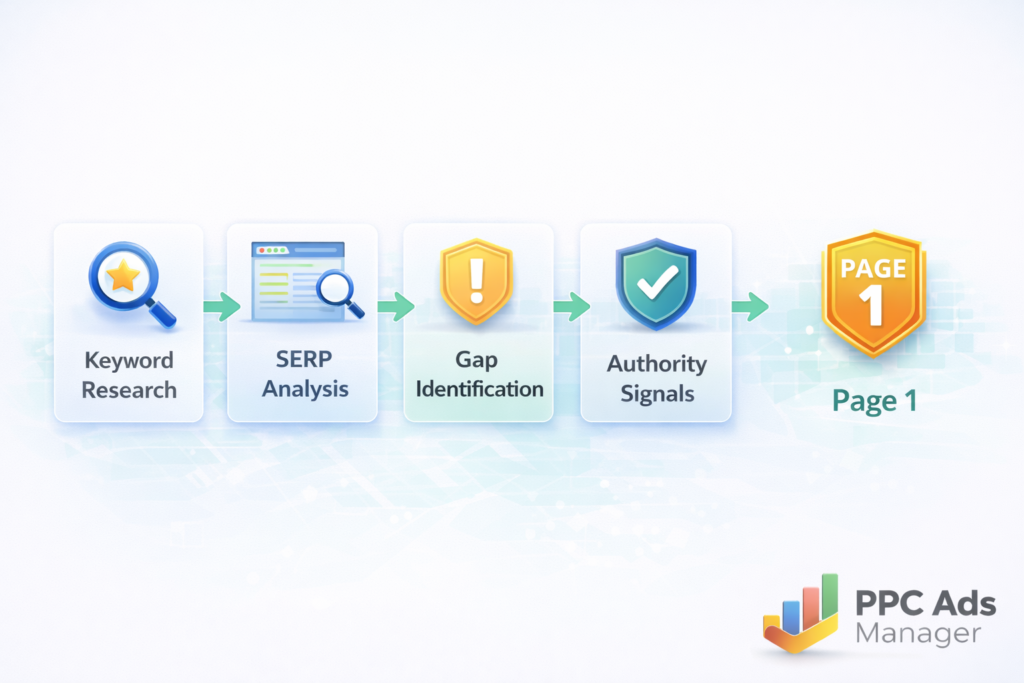
That’s how Page 1 is built.
EEAT: The Real Ranking Filter
Google’s EEAT framework (Experience, Expertise, Authoritativeness, Trustworthiness) separates average blogs from Page 1 content.
In competitive niches like finance, SaaS, health, or marketing, EEAT is non-negotiable.
Weak Example
“SEO is important for business growth.”
Strong Example
“In multiple B2B SaaS campaigns targeting US markets, restructuring content into intent-based clusters improved organic impressions by over 40% within four months.”
Specificity signals experience.
Generic claims signal automation.
Strategic Content vs Volume Publishing
Many brands believe:
“More content = more traffic.”
That logic worked in 2015.
Today, content saturation means differentiation matters more than frequency.
Comparison Table
| Strategy | Outcome |
| 20 AI-written generic blogs/month | Low engagement, weak authority |
| 6 strategic, deeply researched blogs/month | Higher rankings, stronger authority |
| Cluster-based publishing | Sustainable growth |
| Random topics | Weak topical relevance |
Google measures depth, not just count.
Search Intent Alignment: The Hidden Ranking Factor
Page 1 content answers intent precisely.
Before writing any blog, ask:
- Is the user researching?
- Comparing options?
- Ready to buy?
- Looking for local service?
Example:
Keyword: “SEO content strategy”
Intent:
Informational + commercial.
Your blog must:
- Explain strategy
- Provide examples
- Show benchmarks
- Guide toward services
If you only define terms, you lose.
Content Differentiation in Competitive Niches
In high-competition global markets, ranking requires:
- Unique angles
- Updated data
- Clear frameworks
- Real case insights
Industry benchmarks often show:
- 1,200–2,000 word depth
- Strong internal linking
- Backlink support
- Structured formatting
But structure alone is not enough.
Differentiation wins.
Example:
Instead of:
“Top SEO Tips for 2026”
Write:
“Why 80% of SEO Content Fails in 2026 and What to Do Instead”
Positioning matters.
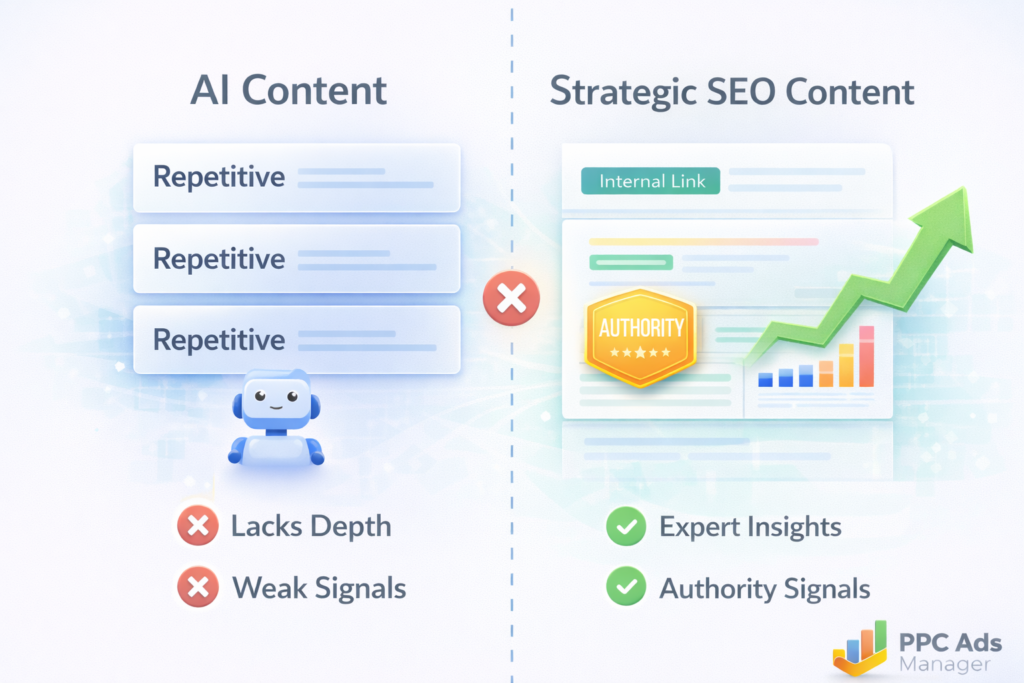
The Problem with Fully Automated AI SEO
When content is fully automated:
- Tone becomes predictable
- Structure repeats across websites
- Insight lacks depth
- Authority signals weaken
Search engines detect similarity patterns.
If your article resembles 100 others, it blends into the background.
Strategic content must:
- Introduce original thinking
- Provide real scenarios
- Avoid template duplication
AI can assist. But it cannot replace expertise.
Building Page 1 Content Framework
Here’s a simplified framework:
1️.Keyword & Intent Research
Identify primary, secondary, and semantic keywords.
2. SERP Analysis
Study top 5 results:
- Word count
- Structure
- Missing angles
3️. Gap Identification
Ask:
- What are they not covering?
- What can I explain better?
4️. Authority Signals
Add:
- Real examples
- Industry practices
- Data references
- Internal linking
5️. Technical Optimization
Ensure:
- Clean URL
- Mobile-friendly
- Fast loading
- Schema markup
Page 1 ranking is engineered.
Common Mistakes Businesses Make
1️. Over-Reliance on AI
Using AI without strategy produces average content.
2️. Publishing Without Clusters
One-off blog posts do not build topical authority.
3️. Ignoring Internal Linking
Internal structure strengthens ranking power.
4️. Chasing Trends Without Relevance
Writing trending topics unrelated to your core services weakens authority.
How Strategic Content Drives Commercial Growth
Page 1 ranking is not just about traffic.
It’s about conversion alignment.
Strategic blogs should:
- Answer core questions
- Link to relevant services
- Include subtle CTAs
- Build brand credibility
Example:
After explaining SEO strategy, naturally guide readers toward consultation services.
Informational content should support revenue goals.
Realistic Timeline for Page 1 Ranking
Even with strategic content:
- Low competition: 2–4 months
- Medium competition: 4–6 months
- High competition: 6+ months
Backlinks, domain authority, and niche saturation influence results.
There is no “instant ranking” shortcut.
Conclusion
Ranking on Page 1 is not about producing more content.
It’s about producing smarter content.
Strategic, AI-controlled (not AI-dependent) SEO content:
- Demonstrates expertise
- Covers intent fully
- Differentiates from competitors
- Aligns with EEAT principles
- Supports commercial objectives
In a world flooded with automated writing, originality and strategic thinking are your competitive edge.
Page 1 is not achieved by chance.
It is built with intent, authority, and precision.
Frequently Asked Questions (FAQs)
1. Can AI-generated content rank on Page 1?
Yes, if it is heavily edited, structured strategically, and enhanced with real expertise. Fully automated content rarely ranks in competitive niches.
2. How long does it take to reach Page 1?
Typically 3–6 months depending on competition, domain authority, and backlink profile.
3. Is AI-free content always better?
Content driven by real expertise and strategic planning performs better. AI should support, not replace, human insight.
4. What matters more: quality or quantity?
Quality. A few strategic, authority-driven articles outperform large volumes of generic content.
Bingi Rohith
SEO Content Strategist & Performance Marketing Specialist