
Introduction
Ranking on Google in a low-competition niche is manageable.
Ranking in a competitive niche is a completely different game.
If you’re targeting global markets like SaaS, finance, health, real estate, or digital marketing, you’re competing with established brands that have:
- Years of domain authority
- Hundreds of backlinks
- Dedicated content teams
- Strong technical SEO foundations
You cannot compete with average blog posts.
You need strategy. Structure. Authority. And alignment with how Google evaluates quality today.
This guide breaks down exactly how to create SEO blog content for Google ranking that ranks in competitive niches using updated EEAT principles, practical frameworks, and real-world industry standards.
What Makes SEO Content Rank in Competitive Niches?
In competitive markets, Google does not reward effort. It rewards superiority.
Your content must be:
- More comprehensive
- Better structured
- More authoritative
- More useful than the top-ranking pages
That’s the standard.
Search Intent vs Search Volume What Actually Wins
Many marketers chase high-volume keywords.
That’s a mistake.
Example 1:
Keyword: “SEO tools”
Volume: Extremely high
Competition: Extreme
Intent: Mixed (informational + commercial)
If you publish a general list article, you will not rank.
Example 2:
Keyword: “best SEO tools for SaaS startups”
Lower volume
Clear commercial intent
More focused audience
The second keyword gives you higher ranking potential and better conversions.
In competitive niches, precision beats volume.
Understanding EEAT in High-Competition Markets
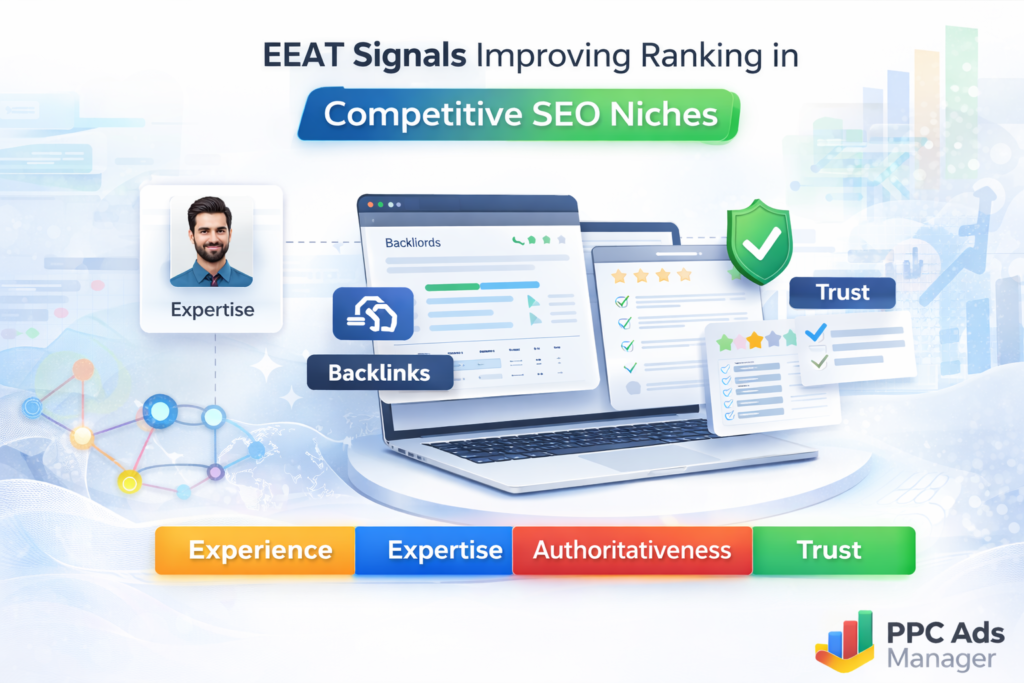
EEAT stands for Experience, Expertise, Authoritativeness, and Trustworthiness.
In competitive spaces, this is not optional.
Google evaluates whether your content demonstrates real-world experience.
Demonstrating Experience
Weak statement:
“SEO improves website traffic.”
Strong statement:
“In a recent audit for a B2B SaaS client targeting US markets, restructuring blog content into intent-based clusters increased organic visibility by 42% in 4 months.”
Specifics show experience. Generic claims do not.
Authority Signals That Matter
In competitive niches, Google looks for:
- Author credentials
- Cited sources
- Industry benchmarks
- Backlink profile
- Consistent topical focus
If your website publishes random topics without depth, it weakens authority.
Trust Signals That Improve Ranking
Trust indicators include:
- Transparent claims
- Updated content
- Clear contact information
- Privacy and policy pages
- No exaggerated promises
If your content promises “guaranteed ranking in 7 days,” you damage credibility.
Keyword Strategy for Competitive Niches
Keyword stuffing is outdated.
Modern SEO is about topical coverage.
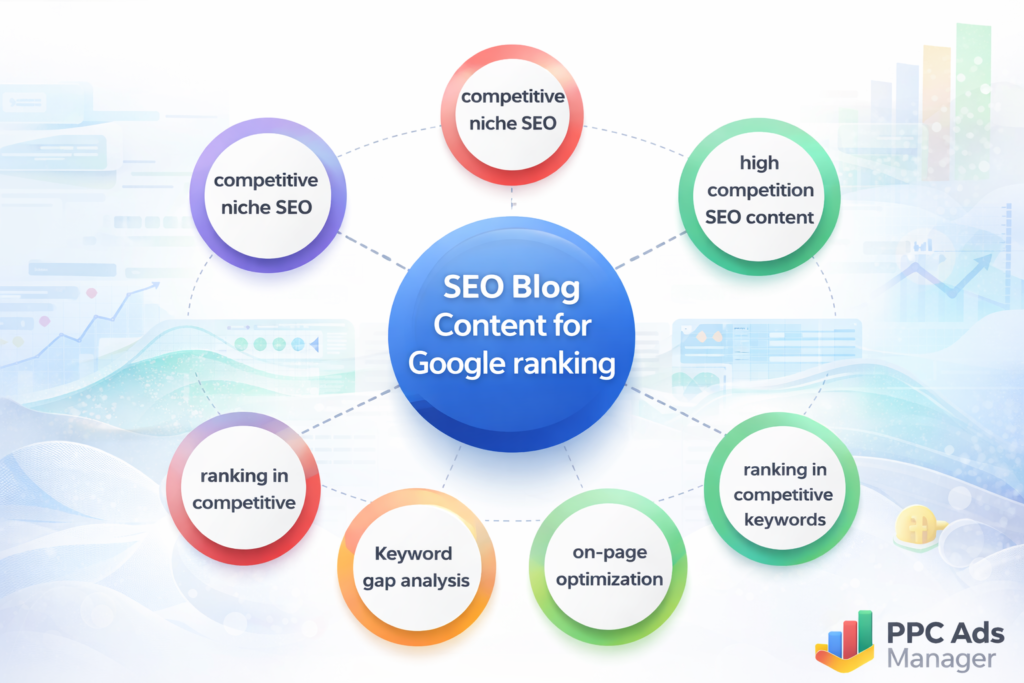
Primary vs Secondary vs Semantic Keywords
Primary keyword:
The main search phrase you want to rank for.
Secondary keywords:
Close variations and intent modifiers.
Semantic keywords:
Contextual phrases Google associates with the topic.
Example:
Primary: SEO blog content for Google ranking
Secondary: competitive niche SEO strategy
Semantic: content clusters, search intent optimization, EEAT signals
Google analyzes relevance depth, not repetition frequency.
Topic Clusters and Content Depth Strategy
In competitive niches, one article is rarely enough.
You need a structured content ecosystem.
Pillar Page Example:
SEO Content Strategy for Competitive Niches
Cluster Articles:
- EEAT implementation guide
- Keyword gap analysis tutorial
- On-page SEO checklist
- Internal linking strategy
- Link-building standards
This structure builds topical authority.
Without it, ranking potential remains limited.
Competitor Gap Analysis Framework
Before writing, analyze:
- Top 5 ranking pages
- Their content depth
- Their headings
- Their backlinks
- Missing angles
Then improve on:
- Clarity
- Updated data
- Practical examples
- Structured formatting
If your content looks similar, you will not outrank them.
It must be noticeably better.
Content Structure That Outranks Big Brands
Structure impacts engagement. Engagement impacts rankings.
SERP Analysis Before Writing
Check:
- Featured snippets
- People Also Ask
- Average word count
- Format patterns
- Media usage
If top-ranking pages average 1,800 words and include visuals, a 900-word plain article won’t compete.
Data, Examples, and Benchmarks
Competitive SEO requires measurable standards.
Example benchmarks in competitive SaaS niches:
- 1,500–2,000 word depth
- 40–70 referring domains
- Strong internal linking
- Quarterly updates
Without benchmarks, strategy lacks direction.
Internal Linking Architecture
Internal linking:
- Distributes authority
- Improves crawl efficiency
- Supports topical relevance
Every competitive SEO article should:
- Link to related blog posts
- Link to service pages
- Support pillar pages
Random linking weakens structure.
Strategic linking strengthens rankings.
On-Page SEO Standards That Still Matter
AI content alone will not rank.
Execution still matters.
Title Optimization Formula
Primary keyword + clear benefit + specificity
Weak:
“SEO Tips”
Strong:
“SEO Blog Content Strategy for Ranking in Competitive Niches”
Clarity improves click-through rate.
Heading Hierarchy & Readability
Use:
- Clear H2 sections
- Logical H3 breakdowns
- Short paragraphs
- Bullet points
Google evaluates readability and structure.
If users leave quickly, rankings drop.
Technical Signals That Affect Ranking
Even strong content fails if technical SEO is weak.
Critical standards:
- Core Web Vitals optimization
- Mobile-first design
- Clean URL structure
- Schema markup
- Fast loading time
Technical weaknesses reduce ranking potential in competitive markets.
Common Mistakes in Competitive SEO Niches
1. Over-Optimization
Excessive keyword repetition reduces readability and trust.
Google understands context. It does not need forced repetition.
2. Thin Topical Authority
Publishing isolated articles without supporting cluster content weakens domain strength.
Depth builds authority.
3. Ignoring Conversion Alignment
Informational content without commercial alignment wastes traffic.
Example:
A blog about SEO strategy should naturally guide readers toward:
- SEO audits
- Consultation services
- Content strategy packages
Traffic without a path to conversion has limited value.
Turning Informational Content into Commercial Growth
Informational content can drive revenue if structured correctly.
Strategic CTAs
Place CTAs:
- After major insight sections
- Before the conclusion
Keep them relevant.
Example:
“Need expert guidance for ranking in competitive markets? Explore our SEO strategy services.”
Lead Magnet Integration
Offer practical value:
- Free SEO audit checklist
- Keyword mapping template
- Competitive gap analysis sheet
This converts readers into leads.
Authority + value = growth.
Conclusion
Ranking in competitive niches is not about publishing more content.
It is about building authority with precision.
You need:
- Intent-focused keyword strategy
- Strong EEAT signals
- Structured topic clusters
- Strategic internal linking
- Technical SEO compliance
- Clear commercial alignment
Competitive markets reward expertise, consistency, and depth.
If your blog content does not demonstrate real-world experience, structured authority, and measurable value, it will not rank globally.
But if you approach SEO strategically treating every blog as part of a larger authority framework ranking becomes achievable.
Not easy.
But achievable.
Frequently Asked Questions (FAQs)
1. How long does it take to rank in competitive SEO niches?
In global competitive niches, ranking typically takes 3 to 6 months, assuming:
- Strong internal linking structure
- 30–70 quality referring domains
- 1,500+ word depth
- Proper EEAT implementation
Without backlinks and authority, it can take significantly longer.
2. Is EEAT really important for non-YMYL niches?
Yes.
While EEAT is critical for YMYL industries (health, finance, legal), it also influences rankings in competitive niches like SaaS and digital marketing.
Google evaluates:
- Author credibility
- Topical authority
- Trust signals
- Content consistency
Even non-YMYL websites lose ranking potential without demonstrated expertise.
3. What word count works best for competitive SEO blog content?
There is no fixed number.
However, in high-competition markets, top-ranking pages usually range between 1,400 to 2,000 words.
More important than word count:
- Depth
- Structure
- Practical examples
- Intent coverage
Long but shallow content does not rank.
4. Can a new website rank in competitive niches?
Yes but only with strategic focus.
A new website should:
- Target long-tail variations first
- Build topic clusters
- Focus on one niche tightly
- Earn authoritative backlinks
Trying to rank broad high-volume keywords immediately is unrealistic.
Bingi Rohith
SEO Content Strategist & Performance Marketing Specialist