Introduction
AI has changed content creation forever.
Tools like ChatGPT can generate blog posts in minutes. Businesses love the speed. Agencies love scalability. Startups love the cost savings.
But one critical question remains:
What actually ranks on Google human-written content or AI-generated content?
The answer is not emotional. It’s strategic.
Google does not rank content based on who wrote it.
It ranks content based on quality, depth, relevance, and authority.
In this guide, we’ll break down what truly ranks in 2026, how AI and human writing differ in SEO performance, and what smart businesses should actually do.
Does Google Penalize AI Content?
No.
Google does not penalize AI content simply because it is AI-generated.
What Google penalizes is:
- Low-quality content
- Thin content
- Repetitive content
- Manipulative content
- Content created only for search engines
Google’s Helpful Content system evaluates usefulness, not authorship.
So the real question becomes:
Which produces better SEO signals average human writing or strategic AI-assisted writing?
Human-Written Content: Strengths and Limitations
Human-written content has natural advantages.
Strengths
1️. Real experience
Humans can share:
- Case studies
- Personal failures
- First-hand insights
- Nuanced opinions
2️. Emotional intelligence
Humans understand:
- Audience psychology
- Tone shifts
- Persuasion techniques
3. Original thinking
True differentiation often comes from human insight.
Limitations
1. Scalability
Human writers are slower.
2️. Cost
High-quality writers are expensive.
3️. Inconsistency
Not all human writers understand SEO structure properly.
A poorly written human blog will not outrank a well-structured AI-assisted one.
ChatGPT-Generated Content: Strengths and Weaknesses
AI tools are powerful when used correctly.
Strengths
1️. Speed
AI can generate structured drafts quickly.
2️. SEO structuring
It can:
- Organize headings
- Maintain keyword placement
- Follow formatting rules
3. Research aggregation
AI summarizes patterns across large datasets.
Weaknesses
1️. Surface-level insights
AI tends to repeat common industry phrases.
2️. Similarity risk
If many websites use similar prompts, content becomes uniform.
3️. Lack of lived experience
AI cannot provide real campaign data unless supplied.
What Actually Ranks in Competitive Niches?
Ranking in competitive niches depends on:
- Intent alignment
- Content depth
- Topical authority
- Internal linking
- Backlink profile
- EEAT signals
Whether AI or human wrote it is secondary.
Example Scenario
Two blogs targeting:
“SEO strategy for SaaS startups”
Blog A:
Fully AI-written, generic advice, no case examples.
Blog B:
AI-assisted draft + human-edited insights + real SaaS growth metrics.
Blog B wins.
Not because it’s “human.”
But because it adds authority.
EEAT: The Real Ranking Filter
Google’s EEAT framework matters more than writing method.
Content must demonstrate:
- Experience
- Expertise
- Authority
- Trustworthiness
AI alone cannot demonstrate experience.
But a human can inject it.
That’s the difference.
AI vs Human Content in High-Competition Markets
In competitive industries like:
- Finance
- Legal
- Healthcare
- SaaS
- Digital marketing
Google favors:
- Specific examples
- Updated references
- Expert attribution
- Unique frameworks
Purely AI-generated content without human enhancement often lacks competitive differentiation.
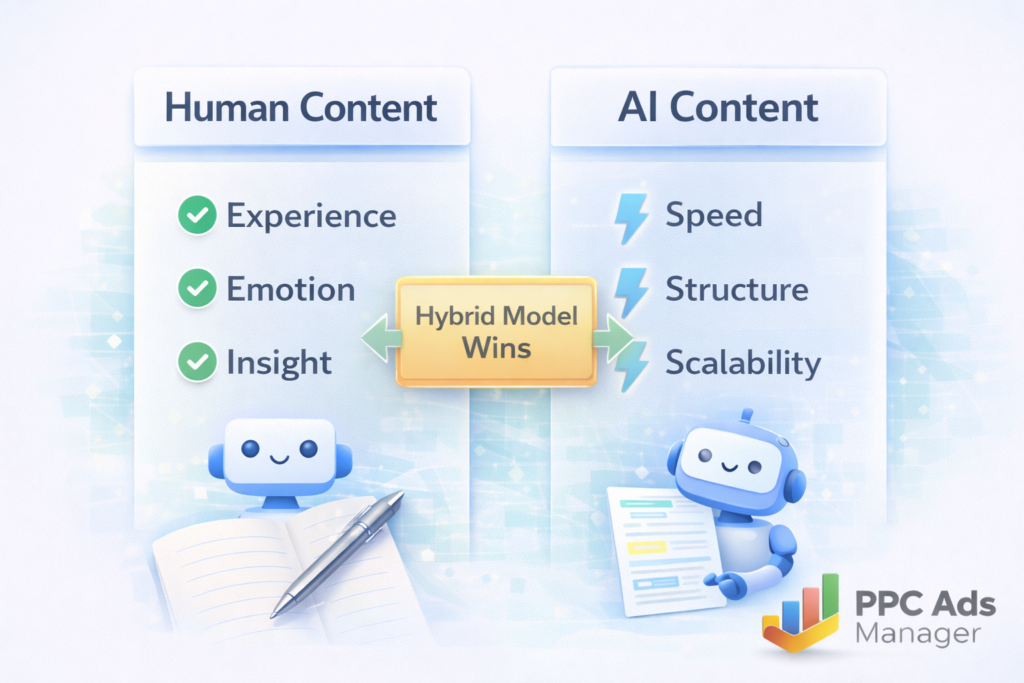
The Hybrid Model: The Real Winner
The smartest SEO strategy today is not “AI vs human.”
It is hybrid.
Hybrid Approach
- AI creates structured drafts.
- Human edits for depth.
- Real examples are inserted.
- Internal linking optimized.
- Strategic positioning refined.
This balances:
- Speed
- Structure
- Authority
- Originality
That’s scalable and competitive.
Content Depth Benchmarks
In medium to high competition niches:
- 1,200–2,000 words
- Strong H2/H3 hierarchy
- FAQ schema
- 2–4 internal links
- 1 external authority reference
- Quarterly updates
Ranking is engineered.
Not guessed.
Common Mistakes Businesses Make
1️. Blindly Publishing AI Output
No editing. No enhancement. No authority signals.
Result:
Low engagement and weak ranking.
2️. Over-Relying on “Human Touch” Without SEO
Beautiful storytelling without keyword structure does not rank.
3️. Ignoring Topical Clusters
One strong article cannot build authority alone.
You need structured content ecosystems.
Does AI Content Get Detected?
There is no reliable public AI detection system used by Google for ranking.
What gets detected is:
- Unhelpful patterns
- Thin value
- Repetitive structures
- Low originality
Google evaluates quality not tool origin.
Commercial Impact: Which Converts Better?
Conversion depends on:
- Trust
- Clarity
- Persuasion
- Authority
Hybrid content often performs best because it combines structure and depth.
If your goal is:
- Lead generation
- Consultation bookings
- Service signups
Authority-driven content wins over volume-driven content.
Realistic Ranking Timeline
Regardless of AI or human writing:
- Low competition: 2–4 months
- Medium competition: 4–6 months
- High competition: 6+ months
Backlinks and authority heavily influence outcomes.
Content method alone does not guarantee ranking.
Conclusion
Human-written vs ChatGPT content is the wrong debate.
The real debate is:
Strategic vs generic.
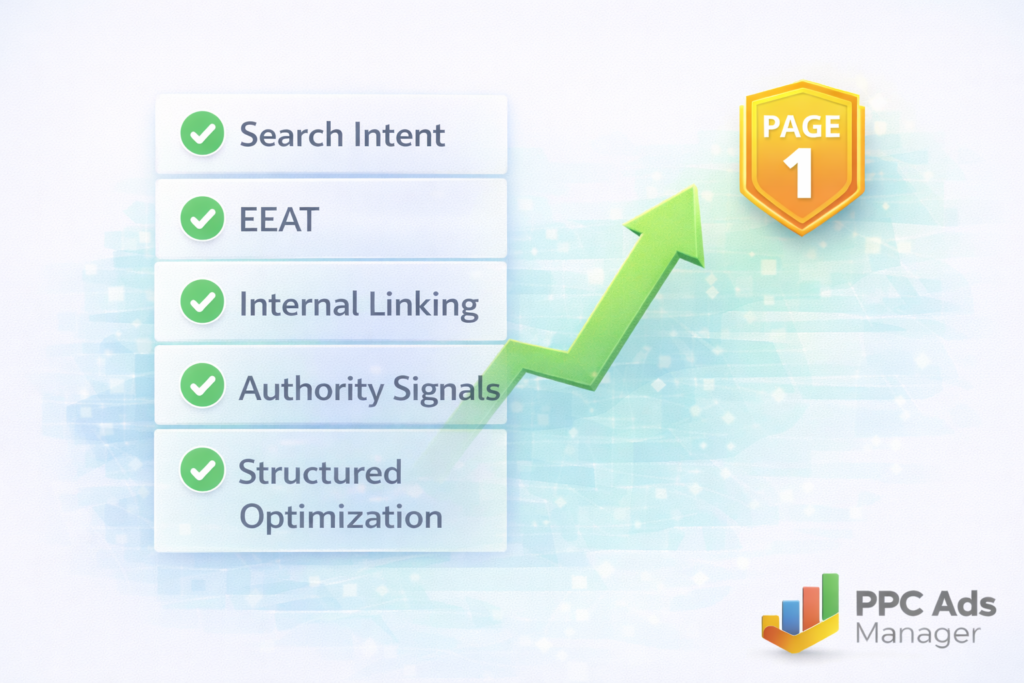
Page 1 rankings are achieved through:
- Intent alignment
- EEAT signals
- Authority integration
- Structured optimization
- Internal linking
- Consistent publishing
AI is a tool.
Humans provide expertise.
The brands that combine both intelligently will dominate search results.
Frequently Asked Questions (FAQs)
1. Can ChatGPT-written content rank on Google?
Yes, if it is optimized, edited, and enhanced with real expertise and authority signals.
2. Is human-written content always better for SEO?
Not necessarily. Poorly structured human content can perform worse than strategic AI-assisted content.
3. Should businesses stop using AI for content?
No. AI should assist content creation, not replace human expertise.
4. What matters most for ranking in 2026?
Search intent alignment, EEAT signals, topical authority, and structured optimization.
Bingi Rohith
SEO Content Strategist & Performance Marketing Specialist