Introduction
Running Google Ads as a small business in the US is not just about spending money.
It’s about spending it correctly.
Many small businesses launch campaigns, get clicks, and then stop because results don’t justify the cost. The problem is rarely the platform.
It’s the strategy.
In 2026, competition is higher, cost-per-click (CPC) is rising, and user expectations are sharper. Without a structured approach, small businesses burn budget fast.
This guide breaks down a practical, proven Google Ads strategy tailored for small businesses focused on generating leads, controlling costs, and improving ROI.
Why Google Ads Still Works for Small Businesses
Despite rising competition, Google Ads remains one of the fastest ways to generate leads.
Key Advantages:
- Immediate visibility on search
- High-intent audience targeting
- Measurable performance
- Scalable campaigns
Example
A local HVAC business in Texas targeting:
“AC repair near me”
Can generate leads within hours of launching ads something SEO cannot do immediately.
Understanding the Google Ads Funnel
Your campaign is not just ads. It’s a system.
Search → Click → Landing Page → Conversion → Follow-up
If any stage fails, your results drop.
| Stage | What Matters |
| Search | Keyword intent |
| Click | Ad copy relevance |
| Landing Page | Speed + clarity |
| Conversion | Offer + CTA |
| Follow-up | Lead nurturing |
Step-by-Step Google Ads Strategy for Small Businesses
1. Start with High-Intent Keyword Research
Small businesses cannot afford wasted clicks.
Focus only on buyer intent keywords.
Examples:
Low Intent:
- “what is google ads”
High Intent:
- “google ads agency near me”
- “plumbing services in California”
- “emergency electrician NYC”
Best Practices:
- Use phrase match and exact match
- Include location-based keywords
- Focus on problem-solving queries
2. Structure Campaigns Properly
A messy campaign = wasted budget.
Recommended Structure:
- Campaign → Based on service
- Ad Group → Based on keyword theme
- Ads → Specific to intent
Example:
Campaign: Plumbing Services
Ad Group: Emergency Plumbing
Keywords:
- emergency plumber near me
- 24/7 plumber USA
3. Write Ads That Drive Action
Your ad is competing with others.
It must stand out.
Weak Ad:
“Best Services Available – Contact Us”
Strong Ad:
“24/7 Emergency Plumbing – Same Day Service | Free Estimate”
What Works in 2026:
- Numbers ($, %, results)
- Urgency
- Clear benefit
- Strong CTA
4. Use Dedicated Landing Pages
Sending traffic to your homepage is a mistake.
Why?
- Too many distractions
- No clear action
- Poor conversion rates
Best Practice:
Create landing pages with:
- One clear offer
- Strong headline
- Trust signals (reviews, testimonials)
- Simple form
5. Optimize for Mobile Users
In the US, most ad clicks come from mobile.
If your landing page is slow or cluttered:
You lose conversions.
Fix:
- Fast loading speed
- Click-to-call buttons
- Simple forms
6. Set Up Conversion Tracking Properly
Without tracking, you’re guessing.
Track:
- Form submissions
- Phone calls
- Purchases
Tools:
- Google Tag Manager
- Google Ads conversion tracking
7. Control Your Budget Smartly
Small businesses often overspend early.
Budget Strategy:
- Start small ($10–$30/day)
- Test keywords
- Scale what works
Industry Benchmarks (US)
| Metric | Range |
| CPC | $1 – $10+ |
| Conversion Rate | 2% – 10% |
| Cost Per Lead | $20 – $200+ |
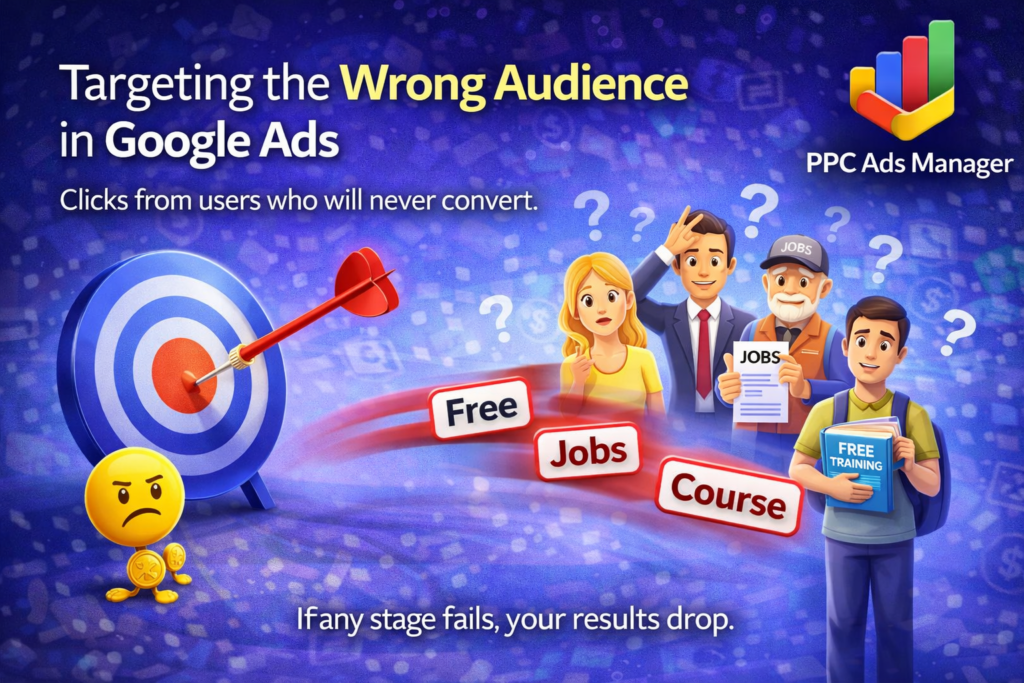
8. Use Negative Keywords
This is where most money is wasted.
Example:
If you run ads for services, exclude:
- free
- jobs
- course
- training
Result:
Better lead quality
Lower cost per click
9. A/B Test Everything
Never run one version.
Test:
- Headlines
- Descriptions
- Landing pages
Goal:
Find what converts best then scale.
10. Use Remarketing to Recover Lost Leads
Most users don’t convert on first visit.
Remarketing helps bring them back.
Strategy:
- Show ads to past visitors
- Offer discounts or reminders
- Use display + search remarketing
Common Mistakes Small Businesses Make
- Targeting broad keywords
- Ignoring landing page quality
- Not tracking conversions
- No negative keywords
- No testing
- Expecting instant results
Real-World Scenario
A small roofing company in Florida:
Initial Campaign:
- Broad keywords
- Homepage traffic
- No tracking
Result:
High clicks, zero leads
After Optimization:
- Exact match keywords
- Landing page created
- Call tracking added
Result:
40% increase in leads within 30 days
Running Google Ads but not seeing results?
You don’t need more budget. You need the right strategy.
Get a free Google Ads audit and find out exactly where your campaigns are losing money.
We’ll analyze your:
- Keywords
- Ads
- Landing pages
- Conversion tracking
And give you a clear plan to improve ROI.
Conclusion
Google Ads can be one of the most powerful tools for small businesses.
But without strategy, it becomes expensive quickly.
The difference between success and failure is not the platform it’s how you use it.
Focus on:
- Intent-driven keywords
- Strong ad copy
- High-converting landing pages
- Continuous optimization
Do this consistently, and Google Ads becomes a predictable lead generation machine.
FAQs
1. How much should small businesses spend on Google Ads?
Most start with $300–$1000/month depending on competition and industry.
2. Is Google Ads worth it for small businesses?
Yes, if campaigns are optimized properly and focused on high-intent keywords.
3. How long does it take to see results?
You can start seeing results within days, but optimization takes 2–4 weeks.
4. What is a good conversion rate for small businesses?
Typically between 2% and 10% depending on industry and targeting.
Bingi Rohith
SEO Content Strategist & Performance Marketing Specialist