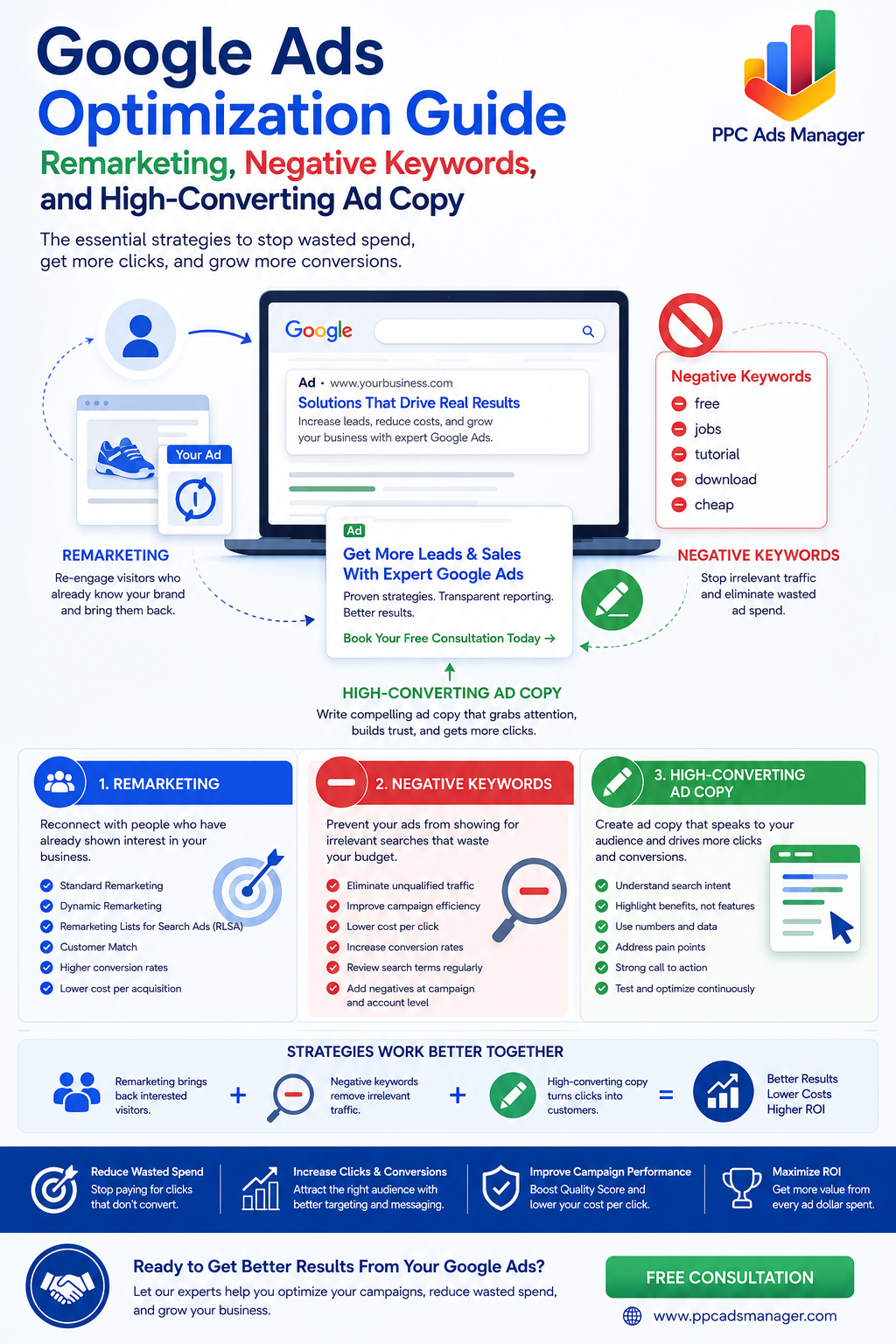
The Essential Strategies Every Google Ads Advertiser Needs to Reduce Waste, Increase Clicks, and Improve Conversions
Running successful Google Ads campaigns requires more than simply choosing keywords and launching ads. Many advertisers spend significant budgets on traffic that never converts, while others struggle to generate clicks despite appearing in search results.
The difference between average and high-performing campaigns often comes down to three critical areas: targeting the right audience through remarketing, eliminating irrelevant traffic with negative keywords, and creating ad copy that encourages users to click.
When these strategies work together, advertisers can improve efficiency, increase conversions, and maximize return on investment without dramatically increasing ad spend.
This guide explores the essential principles behind Google Ads remarketing, negative keywords, and high-performing ad copy so you can build campaigns that generate better results at every stage of the customer journey.
Why Campaign Optimization Matters
Many businesses focus heavily on generating traffic but overlook what happens after campaigns launch.
Without proper optimization:
- Budgets get wasted on irrelevant clicks
- Potential customers leave without converting
- Ads receive poor engagement
- Cost per conversion increases
- Return on ad spend declines
Effective optimization helps advertisers attract qualified users, re-engage interested prospects, and improve overall campaign performance.
Three areas consistently produce the biggest impact:
- Remarketing and retargeting
- Negative keyword management
- High-converting ad copy
Let’s explore each in detail.
Google Ads Remarketing and Retargeting
Most users do not convert during their first visit to a website.
They may research options, compare competitors, evaluate pricing, or simply become distracted before completing an action.
Remarketing helps bring those users back.
What Is Remarketing?
Remarketing allows advertisers to show targeted ads to users who have previously interacted with their website, products, services, mobile app, or YouTube content.
Instead of focusing solely on new visitors, remarketing targets people who already know the brand.
Because these users are familiar with your business, they often convert at significantly higher rates.
How Remarketing Works
The process is straightforward:
- A visitor lands on your website.
- Google tracking records their interaction.
- The visitor is added to an audience list.
- Relevant ads are displayed as they continue browsing online.
- The visitor returns and completes a desired action.
This approach helps businesses stay visible throughout the buying journey.
Types of Remarketing
Standard Remarketing
Displays ads to previous visitors across the Google Display Network.
Dynamic Remarketing
Shows users the exact products or services they viewed before leaving your website.
Remarketing Lists for Search Ads (RLSA)
Targets previous website visitors when they conduct future Google searches.
Customer Match
Uses customer email lists to reconnect with existing customers across Google’s platforms.
Remarketing Best Practices
- Segment audiences based on user intent
- Customize messaging for each audience
- Use compelling calls to action
- Apply frequency caps
- Continuously test creatives
- Prioritize high-intent visitors
Remarketing consistently delivers some of the highest returns in Google Ads because it targets users who already demonstrated interest.
Google Ads Negative Keywords
Driving traffic is important, but preventing irrelevant traffic is equally critical.
Many advertisers unknowingly waste significant portions of their budget because their ads appear for searches that have no chance of converting.
Negative keywords solve this problem.
What Are Negative Keywords?
Negative keywords tell Google when not to show your ads.
When a search contains a negative keyword, your advertisement becomes ineligible to appear.
This helps eliminate unqualified traffic and protects your advertising budget.
Why Negative Keywords Matter
Without negative keywords, businesses often pay for clicks from users who are not potential customers.
Examples include:
- Job seekers
- Students researching information
- Users looking for free products
- Irrelevant product searches
- Competitor-related searches
Negative keywords improve campaign efficiency by filtering out these searches before they generate costs.
Common Negative Keyword Categories
Free Searches
Examples:
- Free
- Trial
- Download
- Sample
Employment Searches
Examples:
- Jobs
- Careers
- Salary
- Internship
Educational Searches
Examples:
- Course
- Tutorial
- Certification
- Training
Research-Based Searches
Examples:
- Definition
- Meaning
- Examples
- What is
The appropriate negatives depend on your specific business goals.
How to Find Negative Keywords
Search Terms Report
The Search Terms Report is one of the most valuable optimization tools in Google Ads.
Review actual search queries regularly and identify irrelevant traffic patterns.
Keyword Research Tools
Keyword research platforms often reveal unwanted variations that should be excluded.
Competitor Analysis
Competitor research may uncover terms attracting low-quality traffic.
Best Practices for Negative Keywords
- Review search terms weekly
- Create campaign-level negative lists
- Maintain account-wide exclusions
- Update negatives regularly
- Separate informational and transactional intent
A strong negative keyword strategy often reduces wasted spend while improving overall conversion rates.
How to Write Google Ads Copy That Actually Gets Clicks
Even perfectly targeted campaigns can struggle if ad copy fails to capture attention.
Strong ad copy encourages users to stop scrolling, click the ad, and visit your website.
Why Ad Copy Matters
Google users are presented with multiple choices for every search.
Your ad must communicate value quickly and clearly.
Effective ad copy improves:
- Click-through rate
- Quality Score
- Conversion rate
- Cost efficiency
- Brand credibility
Understand Search Intent
Before writing any advertisement, understand what the user wants.
Common intent categories include:
Informational Intent
Users are gathering information.
Commercial Intent
Users are comparing options.
Transactional Intent
Users are ready to take action.
Your messaging should align with the user’s stage in the buying process.
Write Benefit-Focused Headlines
Instead of describing features, focus on outcomes.
Weak Headline:
Professional PPC Services
Strong Headline:
Increase Leads With Expert Google Ads Management
Users respond more strongly to benefits than features.
Include Numbers When Possible
Specific figures attract attention and improve credibility.
Examples:
- Increase Conversion Rates by 35%
- Save Up to 25% on Advertising Costs
- Over 500 Successful Campaigns Managed
Numbers make claims feel more tangible and trustworthy.
Address Customer Pain Points
Effective advertising demonstrates understanding.
Examples:
- Struggling With High Cost Per Click?
- Wasting Budget on Low-Quality Leads?
- Need More Qualified Enquiries?
Pain-point-focused messaging creates immediate relevance.
Create Strong Calls to Action
A clear next step improves engagement.
Examples:
- Book Your Free Consultation
- Get a Custom Strategy
- Request a Free Audit
- Start Growing Today
Every ad should encourage users to take action.
Leverage Ad Extensions
Ad extensions increase visibility and provide additional information.
Useful extensions include:
- Sitelinks
- Callouts
- Structured snippets
- Call extensions
- Location extensions
These assets often improve both click-through rate and overall ad performance.
Test Multiple Variations
The highest-performing ads are rarely created on the first attempt.
Continuously test:
- Headlines
- Descriptions
- Calls to action
- Value propositions
- Emotional triggers
Ongoing testing reveals what resonates most with your audience.
How These Strategies Work Together
Remarketing, negative keywords, and ad copy are most effective when used together.
Remarketing reconnects with interested visitors.
Negative keywords eliminate irrelevant traffic.
Compelling ad copy encourages qualified users to engage.
Together, these elements create a more efficient advertising system that attracts the right audience, minimizes wasted spend, and improves conversion rates.
Businesses that consistently optimize all three areas often experience stronger campaign performance, lower acquisition costs, and higher returns from their advertising investment.
Final Thoughts
Google Ads success is rarely determined by a single tactic. High-performing campaigns are built through continuous refinement and optimization.
Remarketing helps recover lost opportunities by re-engaging interested visitors. Negative keywords prevent wasted spending by filtering irrelevant traffic. Effective ad copy increases engagement by motivating users to click and take action.
When combined, these strategies create a powerful framework for sustainable advertising growth.
Whether you’re managing campaigns in-house or working with a PPC agency, mastering these fundamentals can significantly improve your results with Google Ads Audit and help you get more value from every advertising dollar spent.
Frequently Asked Questions
What is the difference between remarketing and retargeting?
Remarketing and retargeting are often used interchangeably. Both focus on reconnecting with users who previously interacted with your business.
How often should I review negative keywords?
Most advertisers should review search term reports weekly to identify new negative keyword opportunities.
Why are negative keywords important?
Negative keywords prevent ads from showing for irrelevant searches, reducing wasted spend and improving campaign efficiency.
What makes Google Ads copy effective?
Strong ad copy focuses on benefits, addresses customer pain points, includes clear calls to action, and aligns with search intent.
Does remarketing improve conversion rates?
Yes. Remarketing often generates higher conversion rates because it targets users who are already familiar with your business.
How many ad variations should I test?
Testing at least three to five ad variations per ad group is a common best practice for identifying top-performing messaging.
Can small businesses benefit from these strategies?
Absolutely. Businesses of all sizes can improve efficiency and performance through remarketing, negative keyword management, and better ad copy.
Which optimization strategy should I implement first?
Begin with negative keywords to reduce wasted spend, improve ad copy to increase engagement, and then implement remarketing to recover missed opportunities and increase conversions.
About PPC Ads Manager
At PPC Ads Manager, we believe paid advertising should do one thing above everything else—help businesses grow profitably.
I’ve spoken with business owners who spent months, and sometimes years, investing in advertising without being able to answer a simple question: “Which campaigns are actually making us money?” Most weren’t lacking budget. They were lacking clarity.
That’s why PPC Ads Manager was created.
We help businesses turn advertising spend into measurable business growth through strategic Google Ads management, Meta advertising, Performance Max campaigns, conversion tracking, remarketing, and performance analytics. Every campaign we build starts with one question: What does success look like for your business?
For some businesses, it’s generating more qualified leads. For others, it’s increasing online sales, lowering acquisition costs, improving return on ad spend, or scaling into new markets. Our job is to build advertising systems that support those goals and continuously improve them over time.
Over the years, we’ve worked with businesses across hospitality, eCommerce, healthcare, IT, solar energy, and local service industries. While every business is different, one thing remains the same: we focus on the metrics that actually matter and make decisions based on data, not assumptions.
We’re not interested in vanity metrics. We’re interested in helping businesses make smarter advertising investments and achieve sustainable, long-term growth.
Meet the Founder
Hi, I’m Navneet Singh Chauhan, Founder of PPC Ads Manager.
I’ve spent more than 16 years in digital marketing and over a decade managing paid advertising campaigns across Google Ads, Meta Ads, LinkedIn Ads, analytics, and conversion optimization.
Throughout my career, I’ve had the opportunity to work with startups, growing businesses, and global brands across multiple industries and markets. I’ve managed annual Google Ads budgets exceeding $7.8 million and worked on campaigns for luxury hospitality brands, eCommerce businesses, healthcare providers, IT companies, and solar energy organizations.
My experience has taught me that successful advertising isn’t about spending more money or chasing every new marketing trend. It’s about understanding your customers, asking the right questions, measuring what matters, and consistently improving performance.
I founded PPC Ads Manager because I saw too many businesses receiving complicated reports, vague recommendations, and campaigns that looked busy on paper but didn’t contribute meaningfully to business growth. I wanted to create a more transparent and practical approach to paid advertising—one that focuses on lead quality, profitability, and long-term results.
Everything we recommend on this website comes from real-world experience, continuous learning, and lessons gained from managing campaigns across different industries and markets.
Our Philosophy: The 3Ts
PPC Ads Manager is built on three principles: Transparency, Tenacity, and Transformation. Together, these principles help us earn something that cannot be claimed but must be earned every day—trust.
Transparency
No black boxes. No vanity metrics. No surprises.
You should always know where your advertising budget is being spent, what’s working, what isn’t, and why certain decisions are being made. We believe in full account ownership, honest reporting, clear communication, and educating our clients so they can make informed business decisions with confidence.
Tenacity
We don’t set and forget campaigns.
Digital advertising changes constantly. Competitors adjust their strategies, customer behavior evolves, and platforms update their algorithms. Some campaigns work immediately. Most don’t.
That’s why we continuously test, optimize, analyze, and refine our campaigns. We approach challenges with curiosity, accountability, and a relentless commitment to improving performance because good results rarely happen by accident.
Transformation
Advertising should create measurable business growth.
A campaign that generates clicks but doesn’t improve revenue isn’t a win. We measure success by the quality of leads, profitability, customer acquisition efficiency, and whether advertising is helping your business grow predictably.
Our goal isn’t simply to manage ads. It’s to help businesses turn marketing spend into growth systems that can scale.
The Outcome: Trust
Our internal mantra is simple:
Be transparent in communication, tenacious in execution, and transformational in impact.
Clients trust us because we’re honest about reality, relentless in our pursuit of better performance, and focused on outcomes that genuinely move businesses forward.
At PPC Ads Manager, we’re not here to be another advertising vendor. We’re here to be a long-term growth partner that helps businesses invest in advertising with confidence and build campaigns that deliver real, measurable results.
16+ Years of Digital Marketing Experience | 10+ Years of Paid Media Expertise | $7.8M+ Annual Google Ads Budget Managed | Experience Across Hospitality, eCommerce, Healthcare, IT, Solar & Local Businesses