Most advertisers begin their Google Ads journey by focusing on keywords. While keyword targeting remains a critical component of campaign success, it is only one piece of the puzzle. As competition increases and acquisition costs rise, advertisers need more sophisticated ways to reach the right users at the right time.
This is where audience targeting becomes a powerful advantage.
Google Ads audience targeting allows businesses to move beyond what people are searching for and understand who those people are, what they are interested in, what they are actively researching, and how likely they are to convert.
When implemented correctly, audience targeting can improve campaign efficiency, reduce wasted ad spend, increase conversion rates, and help businesses scale profitably.
In this guide, we will explore the different audience types available in Google Ads, explain how each works, and show you how to use audience signals strategically to maximise campaign performance.
What Is Google Ads Audience Targeting?
Audience targeting allows advertisers to reach users based on their behaviour, interests, purchasing intentions, demographics, and interactions with a business.
Instead of focusing solely on search queries, audience targeting helps Google identify individuals who are more likely to engage with your products or services.
For example:
A keyword may tell Google that someone searched for “best accounting software.”
An audience signal may tell Google that the same person has recently visited software comparison websites, watched product reviews, and researched pricing pages.
Combining these signals creates a much stronger targeting strategy.
Keyword Targeting vs Audience Targeting
Understanding the distinction between keywords and audiences is essential.
Keyword Targeting
Keyword targeting focuses on what users search for.
Examples include:
- Digital marketing agency
- Running shoes online
- CRM software
- Home renovation services
Keywords reveal immediate intent but provide limited information about the person conducting the search.
Audience Targeting
Audience targeting focuses on who the user is and how they behave online.
It considers factors such as:
- Interests
- Purchase intent
- Browsing habits
- Website interactions
- Previous engagement
- Demographics
Audience targeting adds context to keyword targeting, helping advertisers prioritise users who are most likely to convert.
The strongest campaigns typically combine both approaches.
Why Audience Targeting Matters
As advertising competition grows, relying solely on keywords can become expensive and inefficient.
Audience targeting helps advertisers:
- Improve conversion rates
- Reduce wasted clicks
- Increase return on ad spend
- Reach higher-value prospects
- Improve lead quality
- Create personalised messaging
Audience data provides a competitive advantage that many advertisers fail to fully utilise.
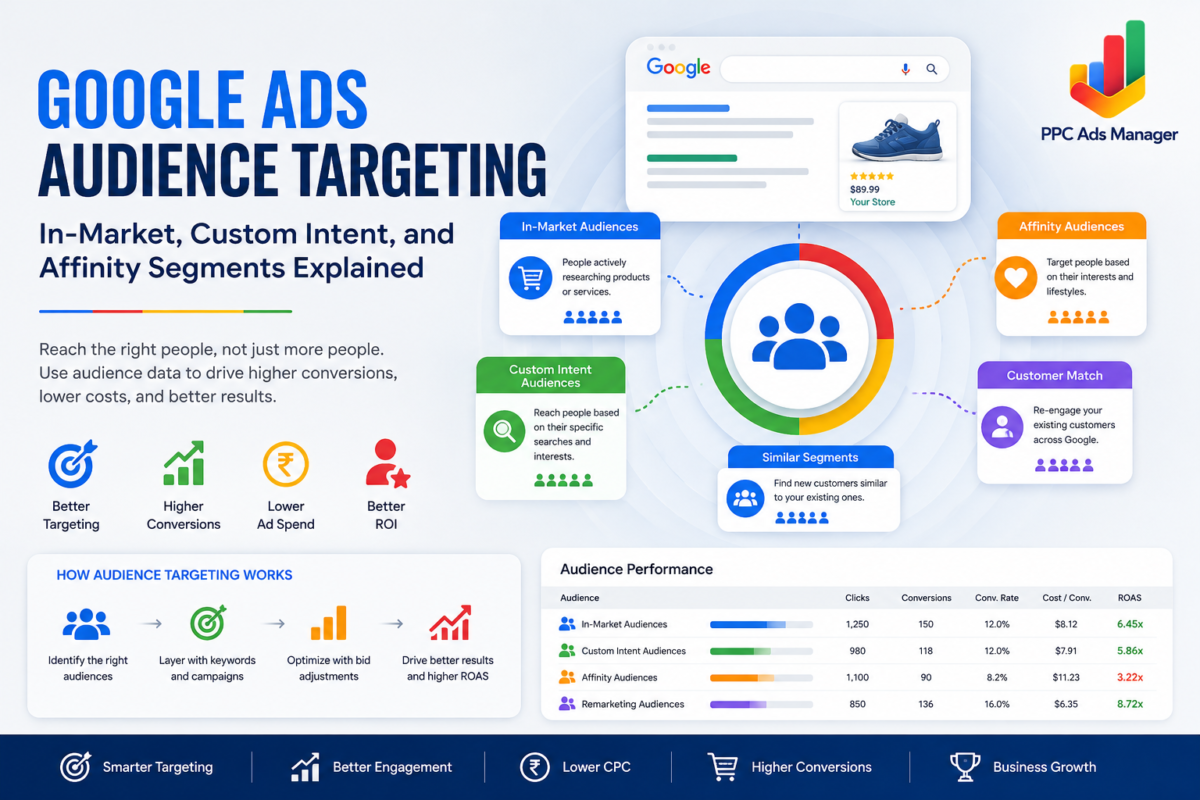
Types of Google Ads Audiences
Google offers several audience categories designed for different marketing objectives.
Each serves a unique purpose within the customer journey.
In-Market Audiences
Affinity Audiences
Custom Intent Audiences
Customer Match Audiences
Similar Segments
Remarketing Audiences
Understanding when and how to use each category is critical for campaign success.
In-Market Audiences
In-Market Audiences target users who are actively researching products or services and are considered close to making a purchase decision.
Google identifies these users based on:
- Recent searches
- Website visits
- Content consumption
- Shopping behaviour
- Comparison activity
These audiences often deliver strong conversion rates because they capture users with clear buying intent.
Examples of In-Market Audiences
- Business software buyers
- Home insurance shoppers
- Luxury travel planners
- Automobile purchasers
- Commercial property seekers
Best Use Cases
In-Market Audiences are ideal for:
- Lead generation campaigns
- E-commerce businesses
- High-intent services
- Product launches
- Seasonal promotions
For many businesses, In-Market Audiences are among the highest-performing audience segments available within Google Ads.
Custom Intent Audiences
Custom Intent Audiences provide advertisers with significantly more control.
Instead of relying on predefined audience categories, advertisers create custom audiences based on keywords, URLs, and interests relevant to their ideal customers.
Google then identifies users who exhibit similar online behaviour.
Example
A PPC agency may create a Custom Intent Audience using:
- Google Ads management
- PPC consultant
- Paid search services
- Competitor agency websites
- Digital advertising platforms
Google uses these signals to find users demonstrating similar research behaviour.
Advantages of Custom Intent Audiences
- Greater targeting precision
- Industry-specific audience creation
- Better alignment with business goals
- Strong prospecting opportunities
Custom Intent Audiences are particularly valuable in niche industries where predefined audience categories may not accurately reflect buyer intent.
Affinity Audiences
Affinity Audiences focus on long-term interests and lifestyle characteristics rather than immediate purchase intent.
Google develops these audiences based on a user’s ongoing online behaviour.
Examples include:
- Technology enthusiasts
- Sports fans
- Business professionals
- Luxury shoppers
- Travel enthusiasts
- Health-conscious consumers
Best Use Cases
Affinity Audiences work exceptionally well for:
- Brand awareness campaigns
- Display advertising
- YouTube advertising
- Top-of-funnel marketing
- New product awareness
Because these audiences are broader, they typically generate lower conversion rates than In-Market Audiences but can provide substantial reach and visibility.
Customer Match Audiences
Customer Match allows businesses to upload first-party customer data and target existing contacts across Google’s advertising ecosystem.
Data sources may include:
- Email addresses
- Phone numbers
- Customer databases
- Subscriber lists
Google securely matches this information with user accounts.
Benefits of Customer Match
- Upsell opportunities
- Cross-selling campaigns
- Customer retention
- Loyalty programmes
- Repeat purchase campaigns
For businesses with established customer databases, Customer Match often becomes one of the most profitable audience strategies available.
Similar Segments
Similar Segments help advertisers discover new prospects who resemble existing customers.
Google analyses characteristics and behaviours of current audiences and identifies users with similar patterns.
These audiences can be highly effective for expanding reach while maintaining relevance.
Common Applications
- Lead generation
- Customer acquisition
- Market expansion
- New audience discovery
When paired with conversion tracking and historical performance data, Similar Segments can accelerate campaign growth significantly.
Remarketing Audiences
Remarketing targets users who have previously interacted with your business.
Examples include:
- Website visitors
- Cart abandoners
- Previous purchasers
- Lead form visitors
- Video viewers
Remarketing audiences often produce some of the highest conversion rates because users already recognise your brand.
For a complete implementation guide, refer to our Google Ads Remarketing Guide.
How to Layer Audiences on Top of Keywords
One of the most effective strategies in Google Ads is combining audience signals with keyword targeting.
Rather than choosing one or the other, advertisers can use both simultaneously.
For example:
Keyword:
- Accounting software
Audience:
- In-Market Business Software Buyers
This combination narrows targeting to users who are both searching for accounting software and actively researching software purchases.
The result is often:
- Higher conversion rates
- Better lead quality
- Improved ROAS
- Lower acquisition costs
Layering audiences provides an additional level of targeting precision that keywords alone cannot achieve.
Observation vs Targeting Mode
Google Ads allows advertisers to apply audiences using two different settings.
Understanding the difference is crucial.
Observation Mode
Observation allows advertisers to collect audience data without restricting campaign reach.
Ads continue serving normally while audience performance is tracked separately.
Benefits include:
- Performance analysis
- Audience discovery
- Bid optimisation opportunities
- Low-risk testing
For most search campaigns, Observation Mode is an excellent starting point.
Targeting Mode
Targeting restricts campaign delivery exclusively to selected audiences.
Only users within the chosen audience segments can see ads.
Benefits include:
- Increased relevance
- Tighter audience control
- Improved lead quality
- More focused budgets
Targeting Mode is often effective for Display, Discovery, YouTube, and highly specialised campaigns.
Bid Adjustments for Audience Segments
Not all audiences perform equally.
Some audiences generate significantly higher conversion rates and deserve additional budget allocation.
Audience bid adjustments allow advertisers to increase or decrease bids based on performance.
Example
Suppose data reveals:
- In-Market Audience: 8% conversion rate
- General Audience: 3% conversion rate
An advertiser may increase bids for the In-Market Audience to gain more visibility among high-value prospects.
Likewise, underperforming audiences can receive reduced bids to improve overall efficiency.
Regular audience analysis is essential for identifying these opportunities.
Best Audiences for Different Business Types
E-Commerce Stores
Best options include:
- In-Market Audiences
- Customer Match
- Remarketing Audiences
- Similar Segments
These audiences help capture both new and returning buyers.
Local Service Businesses
Recommended audiences:
- In-Market Audiences
- Custom Intent Audiences
- Remarketing Lists
These audiences focus on users actively researching services.
B2B Companies
Effective audience types include:
- Custom Intent Audiences
- Customer Match
- Similar Segments
- Business-focused In-Market Audiences
B2B campaigns often benefit from highly customised audience strategies.
SaaS Companies
Top-performing audiences frequently include:
- Software In-Market Audiences
- Custom Intent Segments
- Customer Match Lists
- Website Remarketing Audiences
Professional Services
Law firms, consultants, accountants, and agencies often achieve strong results through:
- Custom Intent Audiences
- In-Market Audiences
- Remarketing Campaigns
These audience types help identify prospects actively evaluating service providers.
Common Audience Targeting Mistakes
Even experienced advertisers can make mistakes when implementing audience strategies.
Common issues include:
Using Broad Audiences Without Segmentation
Broad targeting often reduces efficiency and increases wasted spend.
Ignoring Audience Data
Many advertisers collect audience insights but never act on them.
Skipping Remarketing
Failing to re-engage previous visitors leaves valuable conversions on the table.
Not Testing Observation Mode
Observation Mode provides valuable insights with minimal risk.
Relying Exclusively on Automation
Automated campaigns still require strategic audience guidance.
Successful advertisers continuously evaluate audience performance and adjust targeting accordingly.
Final Thoughts
Keyword targeting remains an important pillar of Google Ads, but audience targeting adds an entirely new layer of intelligence and precision.
By understanding who your customers are, what they are interested in, and where they are in the buying journey, you can create campaigns that generate stronger engagement, higher-quality leads, and better returns on investment.
Whether you use In-Market Audiences to capture ready-to-buy prospects, Affinity Audiences to build brand awareness, Custom Intent Audiences for niche targeting, or Customer Match to reconnect with existing customers, audience targeting provides opportunities that keyword targeting alone cannot deliver.
The most successful advertisers combine audience signals with keyword strategies, conversion tracking, and ongoing optimisation to create campaigns that consistently outperform the competition.
Ready to Reach Better Prospects?
If your campaigns are attracting clicks but not enough conversions, audience targeting could be the missing piece. Our team can review your Google Ads account, identify audience opportunities, and build a smarter targeting strategy designed to improve efficiency and maximise return on ad spend. Request a free campaign review and contact us and discover how audience-focused advertising can help your business grow.