Software as a Service companies operate in one of the most competitive digital marketing environments. Unlike local service businesses that solve immediate problems, SaaS companies often sell products that require education, evaluation, stakeholder approval, and a longer buying journey.
A potential customer may discover your product today, start a free trial next month, and convert into a paying customer several weeks later. This extended decision-making process creates unique challenges for advertisers.
Google Ads remains one of the most effective channels for SaaS growth, but success requires a strategy that balances demand generation with lead generation. Companies that focus only on capturing existing demand often limit their growth potential. Likewise, businesses that invest solely in awareness campaigns may struggle to generate immediate revenue.
This guide explores how SaaS companies can use Google Ads strategically, understand the difference between demand generation and lead generation, and build campaigns that support sustainable growth in 2026.
Understanding the Unique Challenges of SaaS Advertising
Before launching campaigns, it is important to understand why SaaS advertising differs from many other industries.
Longer Sales Cycles
Most SaaS purchases are not impulsive.
A prospect may:
- Research solutions
- Compare competitors
- Watch product demonstrations
- Consult decision makers
- Request approval from management
This means advertisers must nurture prospects over time rather than expecting immediate conversions.
Intangible Products
Unlike physical products, software cannot always be experienced immediately.
Customers often need to understand:
- Features
- Benefits
- Use cases
- Integrations
- Return on investment
Advertising must communicate value clearly and quickly.
Multiple Decision Makers
Many B2B SaaS purchases involve multiple stakeholders.
Marketing managers, operations teams, finance departments, and executives may all influence the final decision.
As a result, messaging should address different concerns throughout the buying process.
High Competition
Many SaaS categories are crowded with established competitors and emerging startups.
Without a strategic approach, advertising costs can escalate quickly while producing inconsistent results.
Demand Generation vs Lead Generation
One of the biggest mistakes SaaS companies make is focusing exclusively on lead generation.
While capturing demand is important, generating demand is equally valuable.
What Is Demand Generation?
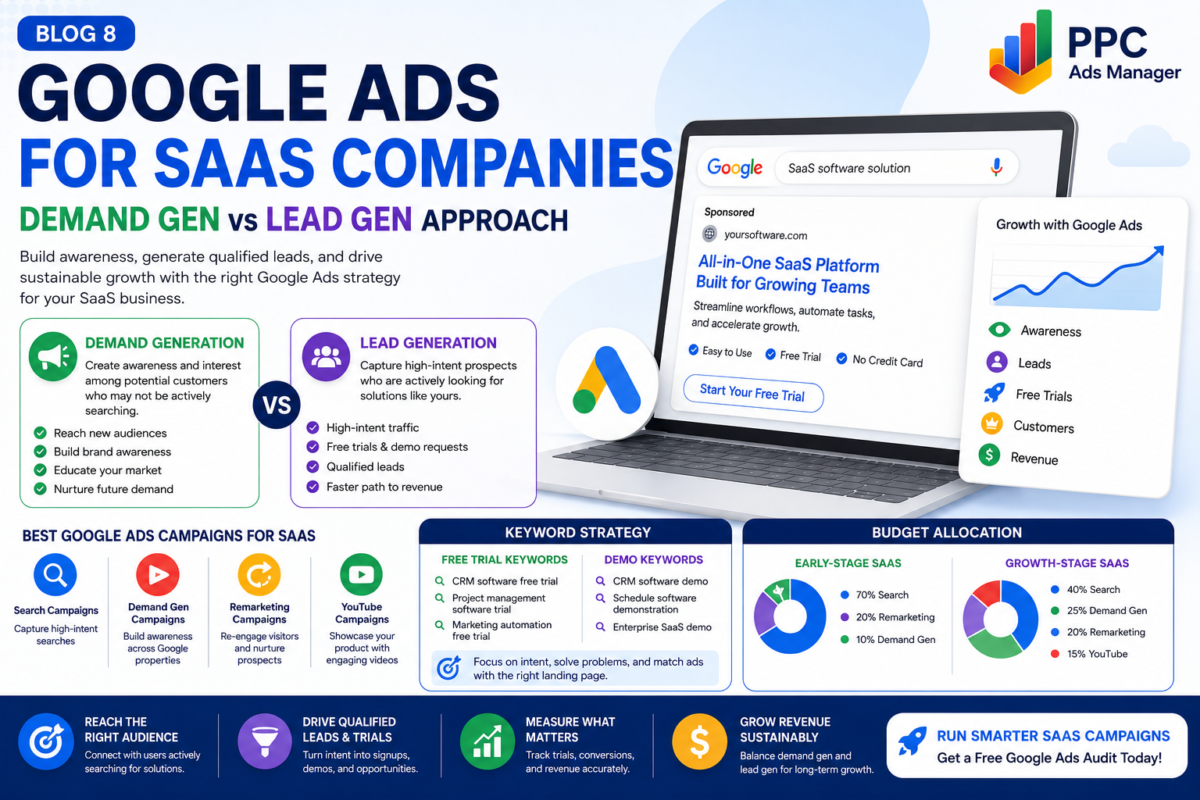
Demand generation focuses on creating awareness and interest among potential customers who may not yet be actively searching for your solution.
The goal is to introduce your brand, educate your audience, and position your product as a solution to a problem they may not have fully recognized.
Examples include:
- Educational content
- Industry insights
- Product comparisons
- Thought leadership campaigns
- Video advertising
Demand generation expands your future pipeline.
What Is Lead Generation?
Lead generation focuses on converting prospects who already recognize a need and are actively evaluating solutions.
Typical lead generation goals include:
- Demo requests
- Free trial signups
- Consultation bookings
- Contact form submissions
These campaigns target users with stronger purchase intent.
Why SaaS Companies Need Both
Demand generation fills the top of the funnel.
Lead generation captures prospects ready to take action.
When combined effectively, these strategies create a predictable and scalable customer acquisition system.
Companies that balance both approaches often experience stronger long-term growth than those relying on a single tactic.
Best Google Ads Campaign Types for SaaS
Different campaign types serve different objectives.
A successful SaaS advertising strategy typically includes multiple campaign formats.
Search Campaigns
Search campaigns remain one of the most effective tools for capturing existing demand.
These campaigns target users actively searching for solutions.
Examples:
- CRM software
- Project management platform
- Marketing automation software
- Customer support tools
Search campaigns often generate highly qualified leads because users already have purchasing intent.
Demand Generation Campaigns
Google’s Demand Gen campaigns allow advertisers to reach users across YouTube, Gmail, Discover, and other Google properties.
These campaigns are useful for:
- Building awareness
- Introducing new products
- Expanding market reach
- Nurturing potential buyers
Demand Gen campaigns help create future demand before prospects begin searching.
Remarketing Campaigns
Many SaaS prospects visit a website multiple times before converting.
Remarketing campaigns allow businesses to reconnect with users who:
- Visited pricing pages
- Viewed product features
- Started a signup process
- Downloaded resources
Remarketing often produces some of the highest conversion rates within a SaaS advertising account.
YouTube Campaigns
Video can simplify complex software concepts.
YouTube campaigns help:
- Demonstrate product functionality
- Build trust
- Showcase customer success stories
- Increase brand awareness
For software companies with sophisticated products, video content can significantly improve engagement.
Keyword Strategy for Free Trials vs Demo Requests
Not all SaaS keywords indicate the same level of intent.
Understanding search behavior allows advertisers to align campaigns with business objectives.
Free Trial Keywords
Users searching for free trials often want hands-on experience.
Examples include:
- Free CRM trial
- Project management software free trial
- Marketing automation trial
- Try help desk software
These searches typically attract prospects in the evaluation phase.
The landing page should emphasize:
- Quick signup
- No-risk testing
- Easy onboarding
- Immediate value
Demo Request Keywords
Demo-focused searches often indicate stronger purchase intent.
Examples include:
- CRM software demo
- Schedule software demonstration
- Enterprise marketing platform demo
- Customer service software consultation
These users may be closer to making a buying decision.
Landing pages should focus on:
- Product walkthroughs
- Personalized demonstrations
- Business outcomes
- Return on investment
High-Intent Commercial Keywords
Some keywords indicate direct buying intent.
Examples:
- Best CRM software
- Marketing automation platform pricing
- Customer support software for enterprises
- Project management software comparison
These terms often deserve higher bids because they attract qualified prospects.
Competitor Keyword Campaigns
Competitor targeting is a common SaaS advertising strategy.
This involves bidding on competitor brand names and related searches.
Examples:
- Alternative to Competitor X
- Competitor X pricing
- Competitor X vs Your Brand
Advantages
Competitor campaigns can:
- Reach high-intent prospects
- Introduce alternatives
- Capture market share
- Generate qualified leads
Best Practices
Focus on differentiation rather than criticism.
Instead of attacking competitors, highlight:
- Unique features
- Better support
- Flexible pricing
- Specialized functionality
Professional positioning often performs better than aggressive comparisons.
Building a High-Converting SaaS Landing Page
A strong Google Ads campaign can generate traffic, but conversions depend heavily on the landing page experience.
Clear Value Proposition
Visitors should immediately understand:
- What the software does
- Who it helps
- Why it is different
Avoid vague messaging.
Focus on outcomes and benefits.
Strong Headline
The headline should reinforce the promise made in the advertisement.
Consistency between ad and landing page improves conversion rates.
Product Demonstration
Visual explanations help visitors understand the platform quickly.
Consider including:
- Product screenshots
- Video demonstrations
- Interactive previews
- Feature highlights
Social Proof
Trust is essential in SaaS marketing.
Include:
- Customer testimonials
- Case studies
- User statistics
- Review ratings
- Industry recognition
Simple Conversion Path
Reduce friction by limiting unnecessary form fields.
Ask only for information that is essential at the current stage.
The easier the signup process, the higher the conversion rate.
Tracking Free Trial Signups and Conversions
Accurate tracking is fundamental to SaaS advertising success.
Without reliable data, optimization becomes difficult.
Essential Conversions to Track
Track actions such as:
- Free trial registrations
- Demo requests
- Contact form submissions
- Webinar registrations
- Qualified leads
- Paid subscriptions
Beyond Initial Conversions
Many SaaS companies stop tracking after a lead is generated.
A better approach is connecting advertising data with customer relationship management systems.
This allows you to measure:
- Trial-to-paid conversion rates
- Customer acquisition cost
- Lifetime value
- Revenue generated
Optimizing toward revenue instead of leads often produces better long-term results.
Budget Allocation for Early-Stage SaaS Companies
Startups and emerging SaaS brands usually operate with limited budgets.
Efficiency is critical.
Recommended Allocation
- 70% Search Campaigns
- 20% Remarketing
- 10% Demand Generation
Search campaigns capture existing demand and often produce the quickest results.
Remarketing helps maximize value from acquired traffic.
Demand generation begins building future awareness.
Budget Allocation for Growth-Stage SaaS Companies
As SaaS businesses mature, they can expand beyond direct-response advertising.
Recommended Allocation
- 40% Search Campaigns
- 25% Demand Generation
- 20% Remarketing
- 15% Video Campaigns
Growth-stage companies benefit from broader awareness strategies while maintaining lead generation performance.
This balanced approach supports long-term scalability.
Common SaaS Google Ads Mistakes
Even experienced advertisers make mistakes that limit performance.
Common issues include:
- Sending traffic to generic homepage pages
- Ignoring audience segmentation
- Tracking only leads instead of revenue
- Using overly broad keywords
- Failing to nurture prospects
- Neglecting remarketing campaigns
- Underinvesting in awareness efforts
Avoiding these mistakes can significantly improve campaign efficiency.
Final Thoughts
Google Ads offers tremendous opportunities for SaaS companies, but success requires more than simply bidding on software-related keywords. Effective SaaS advertising combines demand generation and lead generation to create a balanced growth strategy.
Demand generation introduces your solution to potential buyers before they actively begin searching. Lead generation captures prospects who are already evaluating solutions and ready to take the next step.
By combining strategic campaign selection, intelligent keyword targeting, effective landing pages, accurate conversion tracking, and thoughtful budget allocation, SaaS companies can build a scalable acquisition system that drives sustainable growth.
Whether you are launching a new software platform or scaling an established product, the companies that succeed in 2026 will be those that understand how to create demand, capture demand, and continuously optimize every stage of the customer journey.
Ready to run smarter SaaS campaigns? Get a free Google Ads audit and discover opportunities to increase trials, demos, and revenue while maximizing your advertising investment.
FAQs
1. Are Google Ads effective for SaaS companies?
Yes. Google Ads helps SaaS companies reach users actively searching for software solutions and generate qualified leads through demos, free trials, and consultations.
2. What is the difference between demand generation and lead generation?
Demand generation creates awareness and interest among potential customers, while lead generation focuses on converting users who are already evaluating solutions.
3. Which Google Ads campaign type works best for SaaS?
Search campaigns typically generate the highest-intent leads, while Demand Gen, YouTube, and remarketing campaigns help build awareness and nurture prospects.
4. Should SaaS companies offer free trials or demos?
The answer depends on the product and sales process. Self-service SaaS products often benefit from free trials, while enterprise solutions may perform better with personalized demos.
5. How important is remarketing for SaaS advertising?
Remarketing is extremely important because many SaaS buyers require multiple interactions before making a decision.
6. Should SaaS companies bid on competitor keywords?
Yes, when executed strategically. Competitor campaigns can introduce your solution to prospects already evaluating alternatives.
7. What should a SaaS landing page include?
A strong value proposition, product visuals, social proof, clear benefits, and a simple conversion form.
8. How should startups allocate their Google Ads budget?
Most early-stage SaaS companies benefit from prioritizing search campaigns first, followed by remarketing and demand generation.
9. What conversions should SaaS companies track?
Track free trials, demo requests, qualified leads, paid subscriptions, and revenue whenever possible.
10. Why do many SaaS Google Ads campaigns fail?
Common reasons include poor targeting, weak landing pages, insufficient tracking, lack of remarketing, and focusing only on lead generation while ignoring demand creation.