Introduction
Running ads with a small budget sounds risky.
Most small businesses in the US hesitate because they think:
“You need thousands of dollars to make ads work.”
That’s wrong.
You don’t need a big budget. You need a smart strategy.
Many businesses fail not because they lack money, but because they waste it on poor targeting, wrong keywords, and weak landing pages.
In this guide, you’ll learn how to run effective paid ads on a low budget focusing on high-intent leads, controlled spending, and maximum ROI.
Can You Really Run Ads on a Low Budget?
Yes if you focus on precision over volume.
Instead of reaching everyone, you target the right people.
Example
A local plumbing business in Chicago spending:
$20/day on targeted keywords
vs
$100/day on broad keywords
The smaller budget can generate better leads if optimized correctly.
What “Low Budget” Means in the US Market
For most small businesses:
- $10–$30/day → testing phase
- $30–$100/day → growth phase
Industry Benchmarks
| Metric | Range |
| CPC | $1 – $10+ |
| Conversion Rate | 3% – 10% |
| Cost Per Lead | $20 – $150+ |
Step-by-Step Strategy to Run Ads on Low Budget
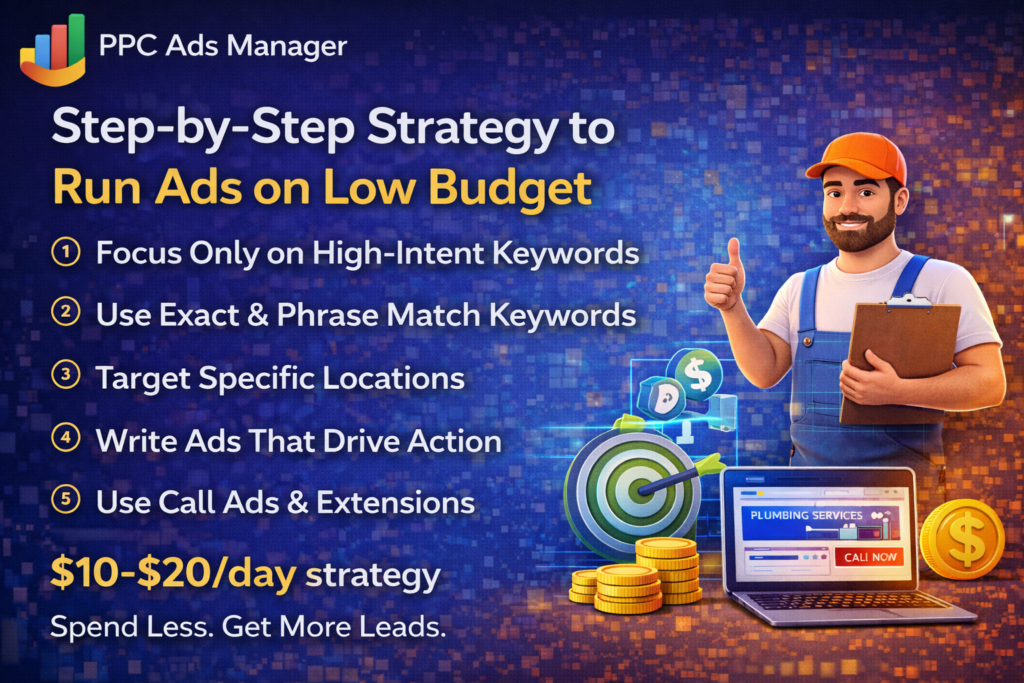
1. Focus Only on High-Intent Keywords
This is the biggest difference between success and failure.
Avoid:
- Informational keywords
- Broad searches
Use:
- “plumber near me”
- “affordable dentist Houston”
- “small business accountant NYC”
Why?
High-intent keywords bring people ready to buy.
2. Use Exact Match and Phrase Match
Broad match = budget drain.
Recommended:
- Exact match → control
- Phrase match → flexibility
Result:
- Lower wasted spend
- Better targeting
3. Target Specific Locations
Don’t target the whole US.
Fix:
- Target city or zip code
- Use radius targeting (5–15 miles)
- Exclude irrelevant areas
4. Write Ads That Drive Action
You can’t afford weak ads on a low budget.
Weak Ad:
“Best Services Available”
Strong Ad:
“Affordable Plumbing Services in Dallas | Call Now”
Must Include:
- Location
- Benefit
- CTA
5. Use Call Ads and Extensions
For local businesses, calls convert faster than forms.
Use:
- Call-only ads
- Call extensions
Result:
Higher conversion rate
Lower cost per lead
6. Create a Simple High-Converting Landing Page
Don’t send traffic to homepage.
Your page should have:
- Clear headline
- Service focus
- One CTA
- Contact form
- Phone number
7. Set a Smart Budget Strategy
Start With:
- $10–$20/day
- 1–2 campaigns only
Then:
- Identify winning keywords
- Increase budget gradually
8. Add Negative Keywords
Without this, your budget leaks.
Add:
- free
- jobs
- course
- DIY
9. Track Conversions from Day One
Without tracking, you’re guessing.
Track:
- Calls
- Form submissions
- Purchases
Tools:
- Google Ads
- Google Tag Manager
10. Optimize Weekly (Not Daily Panic)
Small businesses often panic and change things too fast.
Best Approach:
- Review weekly
- Pause low performers
- Scale winners
Real-World Scenario
A small cleaning service in New York:
Before:
- Broad keywords
- No tracking
- $50/day wasted
After Optimization:
- Exact match keywords
- Local targeting
- Call tracking
Result:
2X increase in leads with same budget
Common Mistakes to Avoid
- Targeting broad audience
- Using homepage as landing page
- No negative keywords
- No tracking
- Expecting instant results
- Changing campaigns too often
Running ads but not seeing results with your budget?
You don’t need more money you need better strategy.
Get a free Google Ads audit and discover how to generate more leads without increasing your ad spend.
We’ll review your:
- Keywords
- Targeting
- Ads
- Landing pages
And give you a clear plan to improve ROI.
Conclusion
Running ads on a low budget is not about spending less.
It’s about spending smarter.
Focus on:
- High-intent keywords
- Strong ad copy
- Local targeting
- Continuous optimization
With the right strategy, even a small budget can deliver consistent leads and growth.
FAQs
1. Can small businesses run ads with $10/day?
Yes, if campaigns are optimized and focused on high-intent keywords.
2. What is the best platform for low-budget ads?
Google Ads is best for high-intent searches, while Facebook Ads work for awareness.
3. How do I reduce cost per click?
Use better targeting, negative keywords, and optimize ad relevance.
4. How long does it take to see results?
You can start seeing results within a few days, but optimization takes 2–3 weeks.
Bingi Rohith
SEO Content Strategist & Performance Marketing Specialist